
The Cboe Volatility Index (VIX), often referred to as the ‘fear gauge,’ surged above 45 following China’s retaliatory measures against U.S. tariffs on April 4. On April 8 (GMT-5), the index reached its highest level in a year at 57.96, marking a prolonged period of market volatility compared to typical spikes. For context, during the global financial crisis of 2008-2009, the VIX peaked at an unprecedented 80.86.
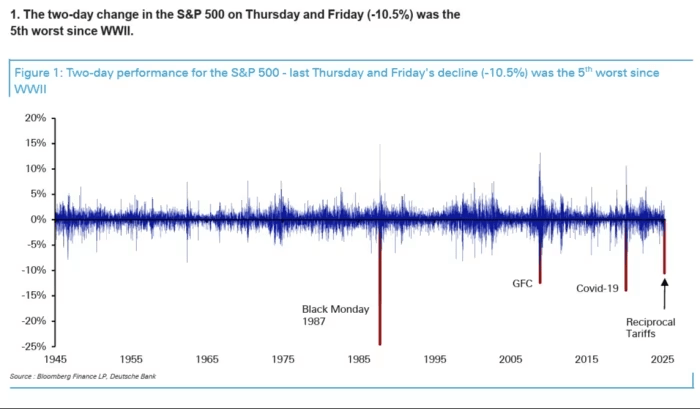
Just a day later, on April 9, the Trump Administration called for a 90-day pause on worldwide tariffs. The VIX has now decreased to healthier values in the 30+ range, as stock markets worldwide experienced a brief reprieve from global panic. However, Trump’s tariffs on China have increased to 145% in response to China’s retaliatory tariffs of 125% on U.S. goods. And in further response to fears on smartphone production, some key electronics made in China are now exempt from the tariffs.
These numbers are likely to continue fluctuating even after this article is published.
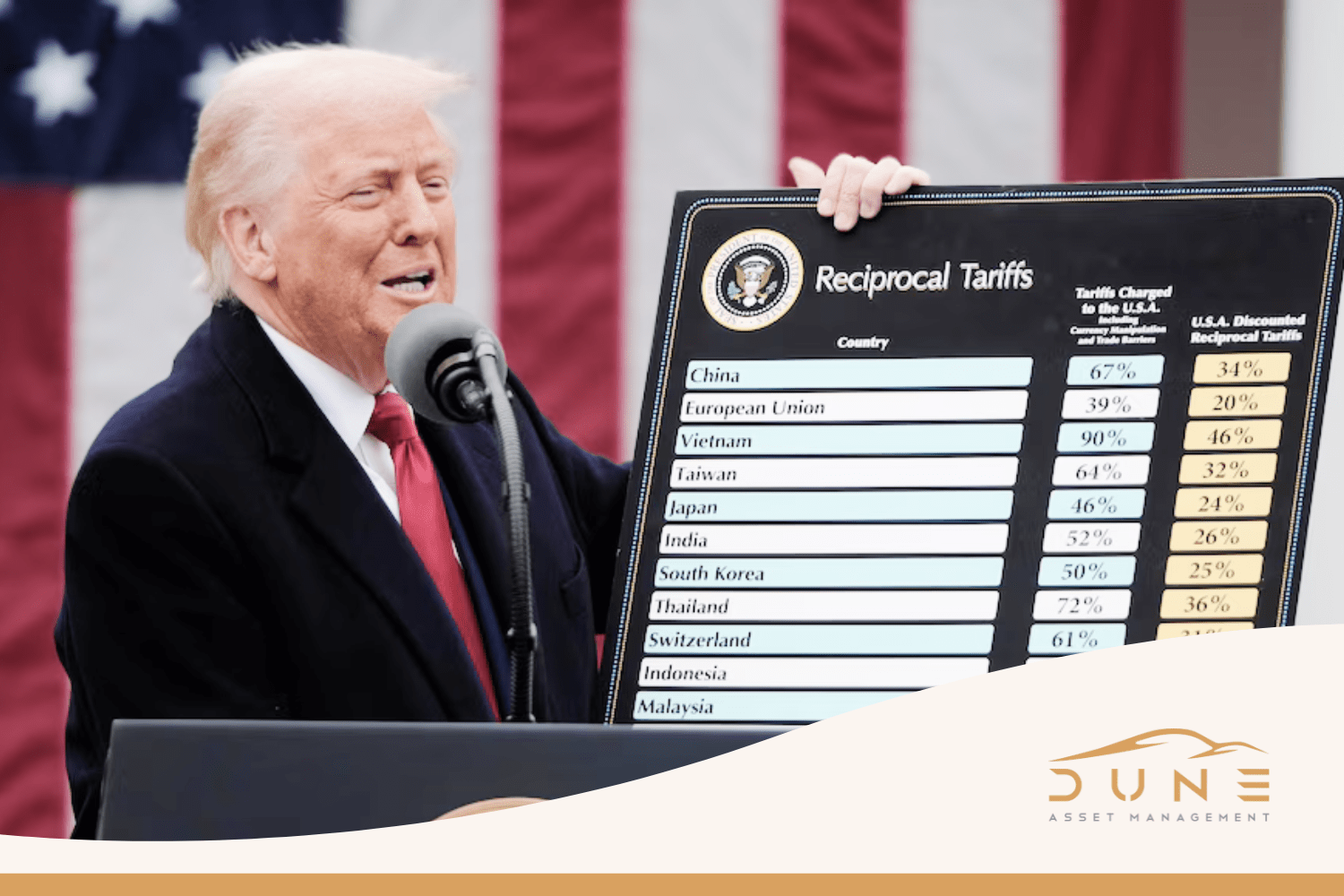
Trump and his administration have been fielding phone calls and negotiation efforts from world leaders since the first tariff announcement rippled through the global economy on April 2. This drastic and dramatic shake-up seems to be what the White House intended, giving the U.S. massive negotiating power with the rest of the world.
“Every country is calling us. That’s the beauty of what we do,” President Trump told reports aboard the Air Force One on April 4. “If we would have asked these countries to do us a favour they would have said no. Now they will do anything for us.”
But for how long will the global pause last? Will the 90-day limit hold? In this economic climate, and for at least the next four years, the only constant is change.
As the world scrambles to mitigate the global effects of one nation’s leadership, we take a look at what could have been, and what might still be, Asia’s future under the tariffs.
Reclaiming Manufacturing Independence?
A prime goal for the Trump administration is to reclaim the country’s global manufacturing, believing the United States should be self-sufficient without having to rely on the global supply chains that have remained the backbone of the world’s economic growth.
According to the Observatory of Economic Complexity (OEC), the United States imported $3.173 trillion worth of goods in 2023 alone. Canada and Mexico made up 28% of all imports and are both still held to the original 25% tariff on goods not covered by the United States-Mexico-Canada Agreement. Europe accounts for a further 28% of U.S. imports.
Within Asia, Cambodia has been hit with the highest U.S. tariffs at a 49% rate, despite having a relatively low trade surplus, followed by Laos at 48%, Vietnam at 46%, and Myanmar at 44%. Thailand was hit with a heavy 36% despite being a U.S. security treaty partner. Sri Lanka is looking at 44% tariff rates, while Bangladesh has 37% on top of its existing 15.6% duty on apparel.
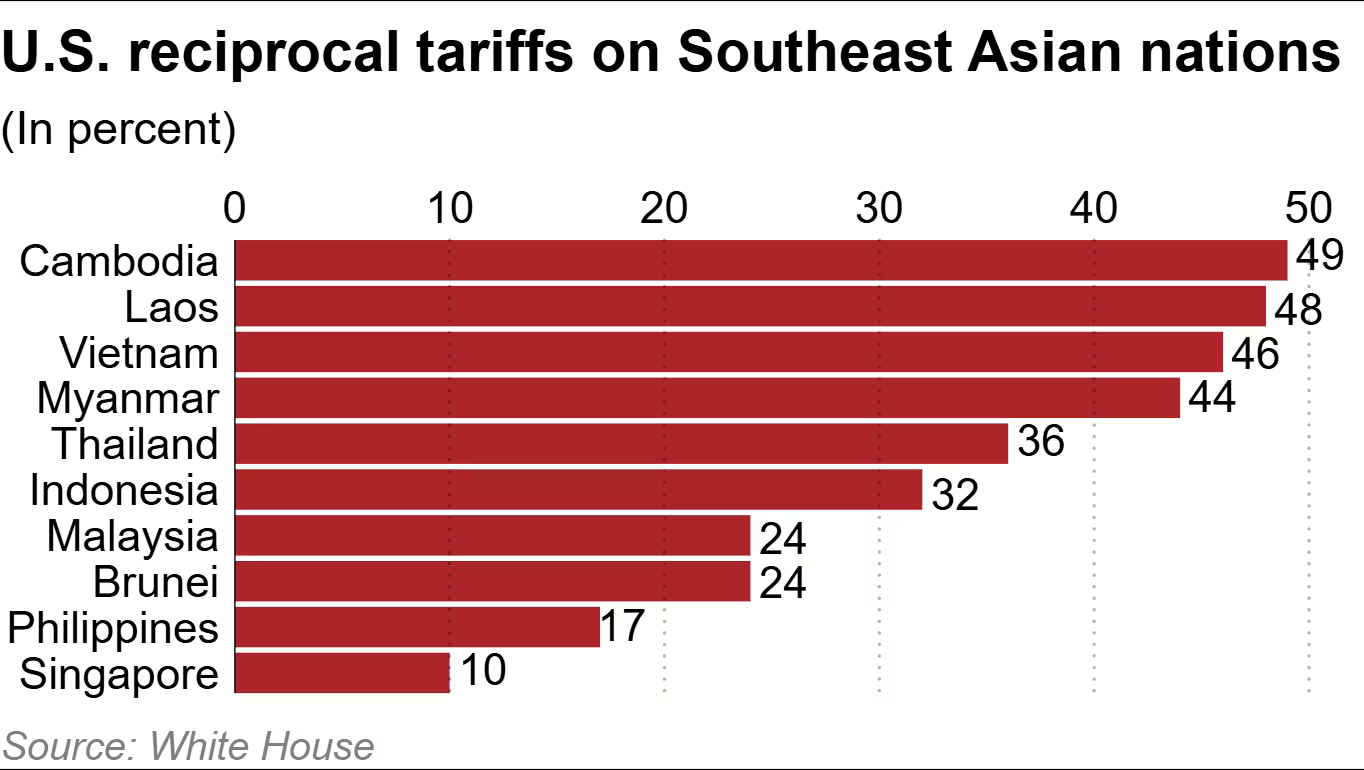
These will replace the Most Favoured Nation (MFN) tariffs for nations under the World Trade Organization (WTO), as well as any existing preferential trade agreements set in place between the U.S. and their trade partners. This includes the existing free trade agreement that Singapore and South Korea have with the United States.
Analysts and economists remain uncertain about how exactly the rates have been calculated. It’s likely that they’re the result of trade deficit divided by export to the U.S. and then halved, but with a minimum value of 10%. If this is the case, it is a decision that does not take into account the many factors that may result in a trade deficit, the trade history between nations, as well as the allyship of those nations with the United States.

It’s likely these lower-middle-income economies export more goods than they’re able to import, resulting in a larger trade deficit. It may also have been weighted to place pressure on countries exporting heavily to China while possibly having the opposite effect of pushing those economies to rely further on Chinese markets.
As of 11th April, China is the only country excluded from the 90-day pause, after raising its tariffs on U.S. products to 125% in response to an equally whopping 145% tariff on Chinese products from the United States. China is the United States’ third-largest trade partner, behind Mexico and Canada.
With the volatility of today’s economic landscape, it pays to be vigilant and on edge. If the tariffs return, their biggest impact would be on the global south. What will the new rates do to the exports of our closest neighbours, and what plans will these countries put in motion to protect their economies from the fallout?
Southeast Asia
Southeast Asia has strategically benefited from the economic rivalry between China and the United States, with manufacturers diversifying their production bases across both nations. It seems the Trump administration may be attempting to punish this behaviour by hitting Southeast Asian nations with some of the highest tariff rates in the world.
According to White House statements, Cambodia’s tariffs on U.S. goods might reach as high as 97%, though independent sources estimate this figure closer to 35%. In response, Cambodia has swiftly lowered its tariffs to approximately 5%, signaling an effort to maintain favorable trade relations with the United States.
Cambodian companies are already looking towards supplying other nations such as Egypt, India and Indonesia, while others still hold out hope for a reversal on the tariffs. But the jury’s still out on how it’ll affect the uncertain landscape of the garment industry.
Weaker currencies and worker wages in Asian countries, particularly in the South—India, Bangladesh, Cambodia, Vietnam, and Indonesia—have made them prime hotspots for manufacturing fast fashion and other high-production retail, which is then exported to the generally wealthier American populace.
This creates a heavy reliance on the U.S. market: Vietnam’s U.S exports are almost a quarter of the nation’s entire GDP, while Cambodia’s massive 45% GDP garment sector provides half of all Cambodia’s U.S. exports. On April 1, in response to news of potential international tariffs, Vietnam immediately cut import duties on cars, liquefied gas and some agricultural products to soften the effects of having the third highest trade deficit with the United States.
Thailand (37%) and the Philippines (17%), the only two formal Southeast Asian allies of the U.S., have both opted to reach out and negotiate with Washington. The Philippines also expressed a willingness to lower their own tariffs on U.S. goods. The Commerce Ministry Permanent-Secretary of Thailand, Vuttikrai Leewiraphan, would negotiate a reduction of tariffs and increased imports on U.S. goods, alongside an increased investment in U.S. energy.
But U.S. brands are similarly reliant on low-cost labour. U.S. textile trade agreements with Cambodia have existed since 1999, establishing low-cost labour for the U.S. when Cambodia’s multi-party democracy was only in its early stages. The Hanoi Times reports that Vietnamese manufacturing, which accounts for nearly 20% of the U.S. textile market, has already secured projects well into the first half of 2025.
In a special economic ministers’ meeting in Malaysia on April 10, ASEAN stated that they intend to pursue a “frank and constructive dialogue with the US to address trade-related concerns,” with no plans for retaliatory measures.
Singapore’s Deputy Prime Minister and Minister for Trade and Industry, Gan Kim Yong, adds that “ASEAN looks forward to constructive dialogue with the US to address concerns and explore enhancing cooperation in areas of mutual interest.”
Economist Jayant Menon spoke with Channel News Asia (CNA), pointing out that such weaponisation of trade policy may lead U.S. trading partners to “consider de-risking not from China, but from the U.S.” And with China clearly being pushed out of the U.S. economy, it might take the opportunity to further economic integration with Southeast Asia with a possible visit to Cambodia, Malaysia and Vietnam from Xi Jinping later this month.
In a Ministerial Statement on April 8, Singapore’s Prime Minister Lawrence Wong expressed his worries about a burgeoning international trade war. “We are very disappointed by the US move, especially considering the deep and longstanding friendship between our two countries,” he stated. “These are not actions one does to a friend.”
South Asia

Bangladesh, the world’s second-largest garment manufacturer, with nearly 80% of its exports in textiles, faces significant challenges under a newly imposed 37% tariff rate. Interim leader Muhammad Yunus reportedly sent a formal request to President Trump asking for a three-month grace period to facilitate initiatives aimed at increasing U.S.-bound exports, according to The Straits Times.
“Bangladesh will take all necessary actions to fully support your trade agenda,” the Chief Adviser had stated.
Bangladesh’s immediate appeasement is not unfounded—it’s possible the nation’s new tariff rate will hike to nearly 53% alongside its existing 15.6% apparel duty. 76% of 1,000 manufacturers surveyed by fair-trade non-profit Transform Trade have reported stagnant order prices between 2020 and 2021, despite the rising cost of energy and materials. However, manufacturers have already been asked to absorb the tariff costs.
Gap, Levi Strauss & Co. and Walmart have been accused of freezing shipments and asking their supply chains to bear the costs of the tariffs rather than passing the cost on to their customers, as Yahoo News reports. These companies, as well as other major apparel brands, have either remained silent or refused to comment on the situation.
There is a genuine fear that Bangladesh’s withdrawal from the American market will cause mass layoffs and unemployment of its 4 million apparel workers, leading to a sharp decline in quality of life alongside an increase in crime.
Many U.S. products imported by Bangladesh, such as agricultural goods and scrap metal, are already duty-free.
The United States is also India’s largest export destination, with a value of $75.81B in the year 2023 alone: 18% of its total exports. India’s overall goods exports may decline by $5.76 billion or 6.41% as a result of its 26% tariff, as reported by the Global Trade Research Initiative (GTRI). Sectors such as gems, jewellery and seafood are expected to be affected.
Its pharmaceuticals are one of the few sectors that may continue to grow by a projected 2.1%, as the industry is currently exempt from the tariffs—though Trump has promised that pharma taxations will be coming soon.
In response, India’s central bank cut interest rates for the second time within a year, reducing the benchmark repo rate by 25 basis points to 6%. India had already cut interest rates in February 2024—for the first time in five years—to boost its economy and ease inflation concerns for its slowing economy before the tariff blitz from the White House.
Regardless, India still intends to engage in bilateral trade negotiations rather than retaliate against the tariffs imposed on its trade.
East Asia
East Asia continues to play a pivotal role in sustaining global technological supply chains. While exemptions on semiconductors may mitigate some impacts for Taiwan, its heavy reliance on exports to the U.S.—a significant driver of economic growth—leaves it vulnerable amid ongoing trade tensions. Taiwanese exports to the U.S. reached a total of USD 111.4 billion in 2024, up by 46.1% year-over-year. This accounts for 20% of Taiwan’s total exports, behind only 27% to China and Hong Kong.
Though the most heavily taxed industries, such as steel and automobiles, make up a minimum of Taiwan’s exports, its cost-competitiveness is likely to take a hit when reaching the U.S. market with its new 32% overall tariff rate. It’s possible that Taiwan may find alternative buyers, but the blow to its general economic growth is clear.
While South Korea and Japan will also enjoy the exemptions on semiconductors and pharmaceuticals, their respective auto industries will be taking a large hit from the 25% tariff rate unaffected by the pause, even with the pauses on global tariffs.
South Korea’s exports to the U.S. hit a record high in 2024, with auto exports and semiconductors taking up 42% of total U.S. exports. In response, its government is planning on financing its auto industry with 15 trillion won, or USD10.18 billion, while supporting automakers’ expanding export markets to the global south.
Japan’s auto industry takes up 20% of total outgoing goods in its already export-heavy economy, with the majority of these exports headed to the American market. President Trump himself declared during his tariff announcements that Japan sells millions of its cars to the U.S., while the United States sells almost none. Deputy chief of staff Stephen Miller has also posted on X that Europe and Japan have shut their markets to American cars while flooding the market with theirs.
While General Motors and Ford barely moved a combined one thousand units in Japan over the past year, it seems the Japanese market simply isn’t as interested in American-made automobiles compared to demand in the United States for Honda Civics. There have been no tariffs on U.S. vehicles from Japan since 1978.
Japanese Prime Minister Shigeru Ishiba spoke to President Trump in a phone call on April 8 and is putting together a team to negotiate with U.S. counterparts. President Trump later told reporters, “So we have a great relationship with Japan. We’re going to keep it that way.”
China

On March 30, China, Japan and South Korea held their first economic dialogue in five years. Chinese state media then reported that the three nations were jointly responding to the U.S. tariffs, which South Korea and Japan were both quick to deny. The joint statement focused primarily on promoting regional and global trade, potentially through a free trade agreement between the three nations. The expected timeline for this free trade agreement has not been stated.
China has long since diversified its markets in an effort to both disentangle its economy from the U.S. as well as increase its influence as a global superpower. Regardless, China is still the United States’ third-largest trade partner, as well as one of only three governing bodies to impose retaliatory tariffs.
U.S. coal, liquefied-natural gas, crude oil, agricultural machinery and large cars were targeted in the first round of retaliation on Feb 10, followed by a large number of U.S. agricultural produce on March 10. These industries are now tariffed at rates of 10% to 15%. The U.S. responded by raising Chinese tariffs to a new total of 54% on April 2. On April 4, China announced an additional 34% would be added to all U.S. goods.
Today, we’re looking at a 125% tariff on U.S. goods from China and a 145% tariff on Chinese imports to the United States.
What does a 145% tariff look like to Chinese and American markets?
The biggest category of U.S. goods exported to China were soybeans, primarily feed for China’s pork industry, followed by aircraft, pharma and petroleum. China mostly imports electronics and telecoms to the United States, most notably Apple’s made-in-China iPhones.
We’re already seeing the effects of this growing trade war. Chinese companies quickly purchased a large amount of soybeans from Brazil, taking advantage of a dip in Brazilian prices. China will also be “moderately” reducing its imports of Hollywood films, cutting access to the world’s second-largest market for films and showing a willingness to target services on top of physically imported goods.
In 2018, Glenn Luk, an Investor at Luke Capital, wrote on Quora that a made-in-U.S. iPhone could cost between $30,000 to $100,000, with only a few million units available a year. This year, Dan Ives—global head of technology research at Wedbush Securities—puts that number closer to $3,500, though he estimates that it’ll cost Apple about $30 billion to move even 10% of their supply chain—a cost that would likely be offset to consumers.
Chinese officials have also cautioned its citizens against travelling to the United States. “China has plenty of tools for retaliation,” posted a state-affiliated media account.
On the other hand, the U.S. is free to continue applying pressure on the rest of the world. Trump’s trade advisor, Peter Navarro, has suggested that the U.S. may apply pressure on countries that it wishes to deter from trading with China, such as Cambodia and Vietnam, by leveraging their access to the U.S. markets their economies rely on.
What's next?
The Trump administration’s view on this U.S.-inflicted global panic is that everyone needs to wait and see what happens and that the market will swing back upwards once the U.S. has equalised its trade deficits.
“[The White House have] said that they don’t care about the stock market right now, they believe that wealthy investors are going to be just fine, and they’re very focused on getting the 10-year Treasury yield down, which is exactly what they’ve been able to do,” said Anthony Pompliano, founder and CEO of Professional Capital Management told Bloomberg in an article examining the global tariffs’ impact on the stock market.
Despite the chaos unleashed upon the market, economists and analysts seem to concur on the stability and growth of the global economy in the long term. “The Americans are taking the ball home, and they are not going to play football with you. So (ASEAN) has to come up with our own game,” Malaysian-American economist Woo Wing Thye tells CNA. “And I think the rest of the world is big enough that, after some adjustment, we will be able to restore everything to normal growth (if we look elsewhere).”
In the wake of the tariff pause, countries continue their negotiations with the White House in the hopes of mitigating the ongoing 25% tariffs on various industries as well as making the pause permanent. Time will tell if the U.S. gets everything it wants in the realm of trade with this drastic move and if sacrificing the goodwill and friendship of its allied countries will pay off in the long run.
But the fear and uncertainty surrounding this move will continue to ripple throughout the rest of Trump’s term. If he’s capable of something like this now, what else can happen in four years? Companies will have to make equally drastic changes to keep their growths stable through these upcoming turbulent times, and the trajectory of different industries and economies will be harder to predict.
The GTRI still expects things to even out over time. “Many exporters may adapt over time, and some sectors may shift production or revise pricing,” it states. “But in the short term, the disruption is likely to be real.”
Concurrent to the effects of the U.S.-China trade war that’s already in motion, experts in the market fear not just a recession but that Trump’s promised benefits to the U.S. economy will never be realised. As Jay Hatfield, CEO of Infrastructure Capital Advisors, tells Bloomberg: “It’s unambiguously horrible, horrible economic policy.”