Presidential Pressure and Policy Independence: Lessons from the Trump – Powell Era

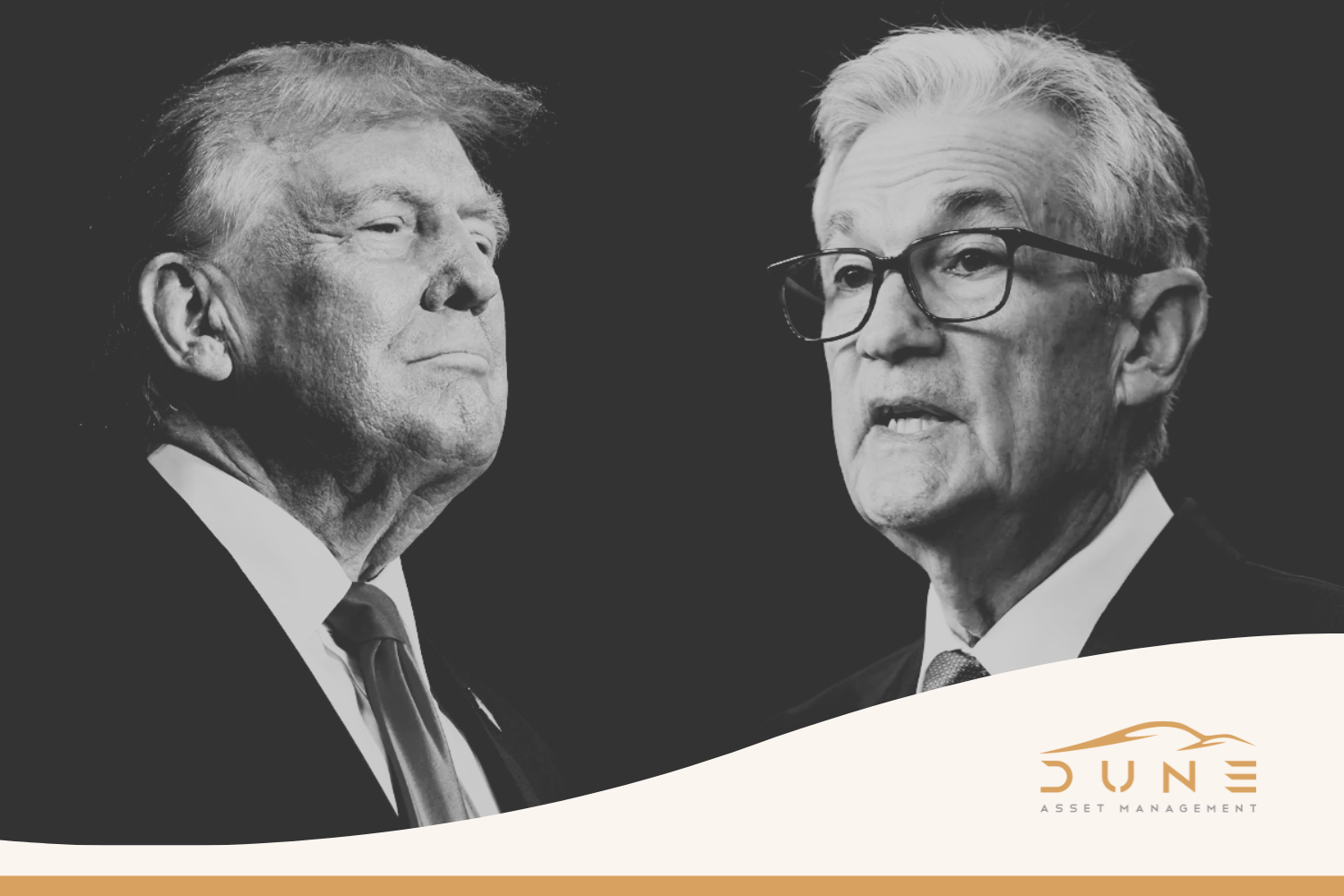
Image showing Trump & Powell coming head to head in the government.

The interplay between the U.S. President and the Federal Reserve Chair has long been characterised by a careful balance, one that aims to maintain the independence of monetary policy while recognising the broader economic and political landscape. Yet, during the overlapping tenures of President Donald Trump and Federal Reserve Chair Jerome Powell, this traditionally discreet relationship gave way to an unusually public and often contentious dynamic. This period’s implications continue reverberating, offering valuable insights for investors navigating today’s increasingly complex global markets.

Diverging Agendas, Rising Tensions

At the heart of the friction was a fundamental divergence in economic priorities. President Trump, driven by a desire to accelerate economic growth and support market performance, consistently urged the Fed to adopt a more accommodative stance, particularly through aggressive interest rate cuts. His demands intensified during periods of heightened uncertainty, most notably amid trade tensions with China and fears of a potential economic slowdown.

Chair Powell, however, remained focused on the Federal Reserve’s dual mandate of price stability and maximum employment. His measured approach, rooted in data-driven analysis and long-term economic health, led the Fed to implement a series of rate hikes throughout 2018. These moves, viewed by Trump as counterproductive to his policy goals, sparked a sustained period of public criticism.

The Unprecedented Public Discourse

Traditionally, presidents have refrained from overt commentary on Federal Reserve policy, thereby preserving the institution’s perceived independence and credibility. Trump, by contrast, frequently took to social media and press events to openly rebuke Powell’s decisions, at times using language that was both personal and inflammatory. In one instance, the President labelled Powell a “major loser” for not reducing rates, while downplaying inflationary concerns.

This highly visible dispute contributed to a climate of uncertainty. Market participants, already navigating a volatile environment, were further unsettled by the prospect of political interference in monetary policymaking. The perception of instability at the highest levels of economic governance added a new layer of complexity to investment decision-making.

Global Repercussions

The repercussions of this strained relationship extended far beyond U.S. borders.

  • Currency Markets: The dollar’s value became a focal point. Trump’s desire for a weaker dollar, aimed at boosting exports, clashed with the Fed’s focus on maintaining price stability. This created volatility in currency markets, impacting global trade and investment flows.
  • Emerging Markets: Emerging economies, often reliant on dollar-denominated debt, were particularly vulnerable to fluctuations in U.S. interest rates. The Fed’s rate hikes, driven by its assessment of the U.S. economy, created headwinds for these markets.
  • Investor Confidence: The public discord between the President and the Fed eroded investor confidence, contributing to market volatility. This uncertainty made it more challenging for businesses and investors to make long-term decisions.
  • Central Bank Independence: The public questioning of the Federal Reserve’s independence created a precedent that other nations observed. This created concerns about the political influence on central banks globally.

Lessons Learned and Future Considerations

The Trump-Powell era underscores the vital importance of institutional independence and highlights the far-reaching consequences of political influence on central banking. For investors and asset managers, this period serves as a powerful reminder of the need to remain highly attuned to the intersection of politics and monetary policy.

Close attention should be paid to the evolving relationship between political leadership and central banks. Even subtle shifts in tone or rhetoric can influence market expectations and lead to significant volatility. Political commentary—especially when it challenges central bank decisions—can quickly filter into asset prices, shaping both short-term sentiment and long-term valuations.

In such an environment, portfolio diversification becomes more than a conventional risk management strategy—it is a necessity. Spreading exposure across asset classes, sectors, and geographies can help insulate portfolios from sudden shocks related to currency movements or shifts in interest rate policy. A well-diversified approach offers resilience in the face of uncertainty and allows investors to adapt more effectively to changing conditions.

Furthermore, a robust understanding of geopolitical dynamics and their economic implications is essential. Political developments, even those that appear isolated or region-specific, can have global repercussions that ripple through financial markets. Staying informed and incorporating geopolitical risk analysis into the investment process is no longer optional—it is integral to sound decision-making in today’s interconnected world.