Where Do We Go From Here?

(10-minute read)  | 

It is the year 2022, and humanity has endured a heck of a time for the past two years, to say the least. From the first reported case of Coronavirus in Wuhan, the ripple effects were like watching a train wreck without knowing if the debris would hit you in the face. Many of the chain reactions set off by policies enacted in the past two years have evolved into severe fundamental issues in their own right, culminating in a royal klusterfuck of epic proportions on Social, Economic, political, and Geopolitical levels.

When we think about where we are now in the cycle, the only word that best describes the situation is “Precipice”, and the following points attempt to conceptualize why.

  • The debt situation in the US at 130% Debt/GDP is unprecedented, last seen since World War 2. This leaves little room for the government to wiggle out because a recession at these levels is politically unpalatable.
  • The energy supply has never been more acute, US Shale has reached peak productivity, and OPEC+ seems to find trouble ramping up production. Higher energy prices are an effective tightening of the economy as it erodes the operating margins of organizations, just when the S&P500 is “richly valued”.
  • In the era of de-globalization, where consumers can no longer easily outsource cheap manufacturing and labour in return for affordable goods, wage increases are needed to sustain the same level of lifestyle. Higher wages are a key inflation metric and will force Central Banks tighter into the corner.
  • The inflation monster returns just when the West has lost pricing power on energy (ESG mandates restrict funding for energy exploration, EU’s dependence on Russian gas to survive emboldens Putin, Germany shutting down nuclear plants increases reliance on energy imports, US Shale peak productivity mean OPEC+ is now the price setter) and when Debt/GDP is at 130%. The result will see the Western world fighting both economic and social issues with two hands tied behind their backs, raising interest rates aggressively to fight inflation and crush your elites as the cost of debt becomes unsustainable, or printing the money and feeding the inflation monster at risk of the working class getting priced out.
  • Ukraine is geopolitically significant because of Europe’s energy hubris. The EU cannot survive without the Russain Gas supply, and Nordstream2 looks like it’s been cancelled. Everything at this point indicates much higher energy prices in time to come. OPEC+ is now the true “Central Bank”, with the ability to tighten or ease the economy and energy prices the wrecking ball. Take a backseat, Powell; he’s just here to keep up the charade.
  • We are transitioning from the age of abundance into an era of shortage as dependencies are being weaponized to create cascading effects that disrupt national efforts. Why should China sell US Rare Earths to build F-35s to sell to Taiwan? And in return, why should the US allow China access to key semiconductor chips at the risk of China overtaking the US in critical technologies?
  • Canada is a microcosm of sentiment concerning Western Democracy. It is fracturing as the divide between the Political Class and Elites versus the Working Class seem unmendable at this point. If you know anything about French-speaking cultures, you know that if the farmers join your protest, you’ve just won and that just is what’s happening in Canada #TruckersForFreedom. We suspect there will be a return of Labour Unions in the Western World, which typically means higher wages and a focus on Labour. What happens when the focus of governments shifts from Capital Market to Labour Markets?

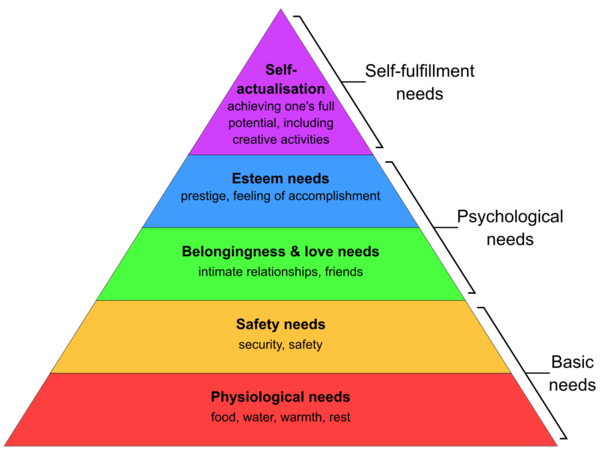
The aforementioned points are an overarching distillation of the current dynamics, which is why I feel that we are in a constant state of flux. We are not in Kansas anymore, Toto, and it seems that the best way to navigate henceforth is to strip it down to what matters. And for that, we have Maslow to guide us.
Peak Self-Actualization

I quote a passage from the late Christopher Lasch’s book The Revolt of the Elites that is worth repeating here:

The thinking classes are fatally removed from the physical side of life… Their only relation to productive labor is that of consumers. They have no experience of making anything substantial or enduring. They live in a world of abstractions and images, a simulated world that consists of computerized models of reality – “hyperreality,” as it’s been called – as distinguished from the palatable, immediate, physical reality inhabited by ordinary men and women. Their belief in “social construction of reality” – the central dogma of postmodernist thought – reflects the experience of living in an artificial environment from which everything that resists human control (unavoidably, everything familiar and reassuring as well) has been rigorously excluded. Control has become their obsession. In their drive to insulate themselves against risk and contingency – against the unpredictable hazards that afflict human life – the thinking classes have seceded not just from the common world around them but from reality itself.

Let’s first identify and categorize two classes of people in society, who we could say tend to navigate and interact with the world in fundamentally different ways: the Thinking Class & the Working Class. The Thinking Class are your Investment Bankers, Finance Guys and Tech Bros, while the Working Class is your Farmers, Construction Workers and Industrialists.

Ever since the West outsourced its manufacturing base to China and emerging markets favouring Wall Street (Thinking Class), fissures in Western society started to appear and deepen as wealth was largely accrued by the Thinking Class. These guys dealt with abstraction and used the power of narratives to shape perception, and people listened because the decades post-1971 was marked by the rapid increase in globalization supported by falling interest rates. This was the period of “abundance” in basic necessities. Hence, people had all the means and energy to pursue the “American Dream” as Maslow’s basic Physiological Needs were well covered.

Fast forward to 2020, and the World Order that we have become so accustomed to is crumbling. China is no longer dependent on Western consumers as Xi Jinping sees that as a fragile economic model and is pursuing his idea of “Dual-Circulation”, encouraging domestic consumption to support local industries. The Middle East is pivoting away from dollar-based oil settlement towards Multi-Currency energy pricing, increasing the Renminbi and Euro volumes of energy settlement. And we all know that this is a considerable threat to the Dollar Hegemony and everything good about QE because the only reason America can get away with all this money printing is its reserve currency status. Putin is showing Tsarist ambitions, shoring up alliances, and forcefully installing more Pro-Russian regimes in former Soviet blocs like Kazakhstan, Belarus, and Ukraine. All these culminate in a highly fragile global order where we are seeing a splintering and redrawing of economic factions and alliances; this means that the worldwide stability unleashed massive deflationary forces that underpinned the “American Dream” due to the security and efficiency of resources is about to change drastically. As a result, we believe that the pendulum is about to swing back to the Working Class in a huge way.

What If It Just Ain't So?

n retrospect, the elements that enabled the era of Peak Self-Actualization gave governments political cover to pursue hubristic economic policies. That allowed the Thinking Class to be rentiers of the hard labour of the Working Class in emerging markets at the expense of the Working Class in developed economies as they see their rice bowl get taken away by foreign factories. Hence it is no surprise we see a clear bifurcation in voting patterns between those living in major cities (beneficiaries of monetary policies) instead of citizens living in the rest of the country (wage stagnation and living paycheck to paycheck). This divide is currently at a tipping point. We are seeing significant political pushback from the working class as inflation broke the camel’s back and exposed the fragility of the global order. The Western world’s response to this to bail the working class out was Modern Monetary Theory (MMT). Unconventional fiscal policy (MMT) undoubtedly strengthened the balance sheet of households to historically healthy levels. It unleashed a massive demand shock onto a faltering supply-chain network, not to mention that the situation is also exacerbated by a supply shock worldwide caused by ESG policies and political change minds.

These events are lining up to cause 2022 to be the year of Tails, and this is worrying because most people are still short convexity (i.e. Long Duration). We suspect that the Fed surfers of the decade’s past who persistently continue to practice their craft (BTFD) in the belief of an omnipotent Fed will be decimated because we are no longer dealing with abstraction but reality. In Maslow’s world of Physiological needs, the strings to economic growth and sustainability are no longer under the purview of the Fed alone. Still, they have been passed onto the Hosue of Saud (Oil pricing power), China’s logistical and manufacturing bases (Supply Chain), Taiwan (Semiconductor availability) and Russia (2nd largest producer of Ammonia, essential for Food security).

Once the world realizes that central banks are no longer Masters Of The Universe, we suspect that the longer-dated yield curve will steepen, and this will drive a massive repricing in growth assets. This proposition is a contrarian take on what’s happening now because we are witnessing in the rates market that participants are front-loading inflation expectations as a near-term issue and transitory in the longer term. The term “transitory” is highly misleading in the grand scheme of things because of base effects. It gives the illusion that inflation is abating as it comes off from high levels when inflation will remain secularly elevated in absolute terms. Once market participants realize that inflation is here to stay in absolute terms and commodity producing countries dictate these terms (cartels), we believe that the longer-dated yield curve will steepen, which will usher in the era of underperformance in long-duration assets (Tech, High Growth).

Back To Basic

As we transition from a world of plenty to a world of “lack”, Maslow indicates that survival at all costs is a fundamental, pertinent and powerful force in the hierarchy of humanity. We suspect that governments will refocus their efforts toward national security, and these will be directed by unprecedented fiscal measures that draw parallels to the Marshall Plan and Manhatten Project. This urgency is exacerbated by the Russian-Ukraine conflict, whose effects have yet to materialize. Eventually, the actual war will be the least important aspect, but full-on Russia-Western financial war is inbound—the whole sanctions package. Gas prices will spike. Russia will trigger alternative currency clauses in its bonds. So much more mess, metals and agricultural commodities. The Cold War 2.0 that ensues will ensure that the deglobalization track will be deeply entrenched and economic factions will become much more definitive; this will mean that commodity exports will likely circulate within a closed-loop economic system. Say goodbye to the Just-In-Time manufacturing process and profit optimization schemes because building robust redundancies into systems will be a matter of survival for countries and organizations. At the moment, there is a massive spread between Optimization (current system) and Redundancy focused systems. This spread is where we want to be heavily invested in and positioned for the next decade.

We are heavily positioned in:

  • Food
  • Energy
  • Uranium
  • Gold & Silver
  • Commodities
  • Critical Infrastructure & Supply-Chain assets
  • Real-Estate with strong Common-Law & Property Rights jurisdictions
  • Bitcoin

Pulse On Humanity

Despite the rather heavy-hearted outlook, we continue to believe that no one should bet against human ingenuity and the human spirit when confronted with insurmountable odds. Crisis and necessity are usually the catalysts for massive innovation, ultimately ushering in a new era. “Hard times create strong men, strong men create good times, good times create weak men, and weak men create hard times.” this quote is by G. Michael Hopf is rather apt as we live through this unprecedented history of our time.

We are lightly positioned in:

  • Edge Networks
  • Critical Semiconductor Companies

(10-minute read)  | 

It is the year 2022, and humanity has endured a heck of a time for the past two years, to say the least. From the first reported case of Coronavirus in Wuhan, the ripple effects were like watching a train wreck without knowing if the debris would hit you in the face. Many of the chain reactions set off by policies enacted in the past two years have evolved into severe fundamental issues in their own right, culminating in a royal klusterfuck of epic proportions on Social, Economic, political, and Geopolitical levels.

When we think about where we are now in the cycle, the only word that best describes the situation is “Precipice”, and the following points attempt to conceptualize why.

  • The debt situation in the US at 130% Debt/GDP is unprecedented, last seen since World War 2. This leaves little room for the government to wiggle out because a recession at these levels is politically unpalatable.
  • The energy supply has never been more acute, US Shale has reached peak productivity, and OPEC+ seems to find trouble ramping up production. Higher energy prices are an effective tightening of the economy as it erodes the operating margins of organizations, just when the S&P500 is “richly valued”.
  • In the era of de-globalization, where consumers can no longer easily outsource cheap manufacturing and labour in return for affordable goods, wage increases are needed to sustain the same level of lifestyle. Higher wages are a key inflation metric and will force Central Banks tighter into the corner.
  • The inflation monster returns just when the West has lost pricing power on energy (ESG mandates restrict funding for energy exploration, EU’s dependence on Russian gas to survive emboldens Putin, Germany shutting down nuclear plants increases reliance on energy imports, US Shale peak productivity mean OPEC+ is now the price setter) and when Debt/GDP is at 130%. The result will see the Western world fighting both economic and social issues with two hands tied behind their backs, raising interest rates aggressively to fight inflation and crush your elites as the cost of debt becomes unsustainable, or printing the money and feeding the inflation monster at risk of the working class getting priced out.
  • Ukraine is geopolitically significant because of Europe’s energy hubris. The EU cannot survive without the Russain Gas supply, and Nordstream2 looks like it’s been cancelled. Everything at this point indicates much higher energy prices in time to come. OPEC+ is now the true “Central Bank”, with the ability to tighten or ease the economy and energy prices the wrecking ball. Take a backseat, Powell; he’s just here to keep up the charade.
  • We are transitioning from the age of abundance into an era of shortage as dependencies are being weaponized to create cascading effects that disrupt national efforts. Why should China sell US Rare Earths to build F-35s to sell to Taiwan? And in return, why should the US allow China access to key semiconductor chips at the risk of China overtaking the US in critical technologies?
  • Canada is a microcosm of sentiment concerning Western Democracy. It is fracturing as the divide between the Political Class and Elites versus the Working Class seem unmendable at this point. If you know anything about French-speaking cultures, you know that if the farmers join your protest, you’ve just won and that just is what’s happening in Canada #TruckersForFreedom. We suspect there will be a return of Labour Unions in the Western World, which typically means higher wages and a focus on Labour. What happens when the focus of governments shifts from Capital Market to Labour Markets?

The aforementioned points are an overarching distillation of the current dynamics, which is why I feel that we are in a constant state of flux. We are not in Kansas anymore, Toto, and it seems that the best way to navigate henceforth is to strip it down to what matters. And for that, we have Maslow to guide us.

Peak Self-Actualization

I quote a passage from the late Christopher Lasch’s book The Revolt of the Elites that is worth repeating here:

The thinking classes are fatally removed from the physical side of life… Their only relation to productive labor is that of consumers. They have no experience of making anything substantial or enduring. They live in a world of abstractions and images, a simulated world that consists of computerized models of reality – “hyperreality,” as it’s been called – as distinguished from the palatable, immediate, physical reality inhabited by ordinary men and women. Their belief in “social construction of reality” – the central dogma of postmodernist thought – reflects the experience of living in an artificial environment from which everything that resists human control (unavoidably, everything familiar and reassuring as well) has been rigorously excluded. Control has become their obsession. In their drive to insulate themselves against risk and contingency – against the unpredictable hazards that afflict human life – the thinking classes have seceded not just from the common world around them but from reality itself.

Let’s first identify and categorize two classes of people in society, who we could say tend to navigate and interact with the world in fundamentally different ways: the Thinking Class & the Working Class. The Thinking Class are your Investment Bankers, Finance Guys and Tech Bros, while the Working Class is your Farmers, Construction Workers and Industrialists.

Ever since the West outsourced its manufacturing base to China and emerging markets favouring Wall Street (Thinking Class), fissures in Western society started to appear and deepen as wealth was largely accrued by the Thinking Class. These guys dealt with abstraction and used the power of narratives to shape perception, and people listened because the decades post-1971 was marked by the rapid increase in globalization supported by falling interest rates. This was the period of “abundance” in basic necessities. Hence, people had all the means and energy to pursue the “American Dream” as Maslow’s basic Physiological Needs were well covered.

Fast forward to 2020, and the World Order that we have become so accustomed to is crumbling. China is no longer dependent on Western consumers as Xi Jinping sees that as a fragile economic model and is pursuing his idea of “Dual-Circulation”, encouraging domestic consumption to support local industries. The Middle East is pivoting away from dollar-based oil settlement towards Multi-Currency energy pricing, increasing the Renminbi and Euro volumes of energy settlement. And we all know that this is a considerable threat to the Dollar Hegemony and everything good about QE because the only reason America can get away with all this money printing is its reserve currency status. Putin is showing Tsarist ambitions, shoring up alliances, and forcefully installing more Pro-Russian regimes in former Soviet blocs like Kazakhstan, Belarus, and Ukraine. All these culminate in a highly fragile global order where we are seeing a splintering and redrawing of economic factions and alliances; this means that the worldwide stability unleashed massive deflationary forces that underpinned the “American Dream” due to the security and efficiency of resources is about to change drastically. As a result, we believe that the pendulum is about to swing back to the Working Class in a huge way.

What If It Just Ain't So?

n retrospect, the elements that enabled the era of Peak Self-Actualization gave governments political cover to pursue hubristic economic policies. That allowed the Thinking Class to be rentiers of the hard labour of the Working Class in emerging markets at the expense of the Working Class in developed economies as they see their rice bowl get taken away by foreign factories. Hence it is no surprise we see a clear bifurcation in voting patterns between those living in major cities (beneficiaries of monetary policies) instead of citizens living in the rest of the country (wage stagnation and living paycheck to paycheck). This divide is currently at a tipping point. We are seeing significant political pushback from the working class as inflation broke the camel’s back and exposed the fragility of the global order. The Western world’s response to this to bail the working class out was Modern Monetary Theory (MMT). Unconventional fiscal policy (MMT) undoubtedly strengthened the balance sheet of households to historically healthy levels. It unleashed a massive demand shock onto a faltering supply-chain network, not to mention that the situation is also exacerbated by a supply shock worldwide caused by ESG policies and political change minds.

These events are lining up to cause 2022 to be the year of Tails, and this is worrying because most people are still short convexity (i.e. Long Duration). We suspect that the Fed surfers of the decade’s past who persistently continue to practice their craft (BTFD) in the belief of an omnipotent Fed will be decimated because we are no longer dealing with abstraction but reality. In Maslow’s world of Physiological needs, the strings to economic growth and sustainability are no longer under the purview of the Fed alone. Still, they have been passed onto the Hosue of Saud (Oil pricing power), China’s logistical and manufacturing bases (Supply Chain), Taiwan (Semiconductor availability) and Russia (2nd largest producer of Ammonia, essential for Food security).

Once the world realizes that central banks are no longer Masters Of The Universe, we suspect that the longer-dated yield curve will steepen, and this will drive a massive repricing in growth assets. This proposition is a contrarian take on what’s happening now because we are witnessing in the rates market that participants are front-loading inflation expectations as a near-term issue and transitory in the longer term. The term “transitory” is highly misleading in the grand scheme of things because of base effects. It gives the illusion that inflation is abating as it comes off from high levels when inflation will remain secularly elevated in absolute terms. Once market participants realize that inflation is here to stay in absolute terms and commodity producing countries dictate these terms (cartels), we believe that the longer-dated yield curve will steepen, which will usher in the era of underperformance in long-duration assets (Tech, High Growth).

Back To Basic

As we transition from a world of plenty to a world of “lack”, Maslow indicates that survival at all costs is a fundamental, pertinent and powerful force in the hierarchy of humanity. We suspect that governments will refocus their efforts toward national security, and these will be directed by unprecedented fiscal measures that draw parallels to the Marshall Plan and Manhatten Project. This urgency is exacerbated by the Russian-Ukraine conflict, whose effects have yet to materialize. Eventually, the actual war will be the least important aspect, but full-on Russia-Western financial war is inbound—the whole sanctions package. Gas prices will spike. Russia will trigger alternative currency clauses in its bonds. So much more mess, metals and agricultural commodities. The Cold War 2.0 that ensues will ensure that the deglobalization track will be deeply entrenched and economic factions will become much more definitive; this will mean that commodity exports will likely circulate within a closed-loop economic system. Say goodbye to the Just-In-Time manufacturing process and profit optimization schemes because building robust redundancies into systems will be a matter of survival for countries and organizations. At the moment, there is a massive spread between Optimization (current system) and Redundancy focused systems. This spread is where we want to be heavily invested in and positioned for the next decade.

We are heavily positioned in:

  • Food
  • Energy
  • Uranium
  • Gold & Silver
  • Commodities
  • Critical Infrastructure & Supply-Chain assets
  • Real-Estate with strong Common-Law & Property Rights jurisdictions
  • Bitcoin

Pulse On Humanity

Despite the rather heavy-hearted outlook, we continue to believe that no one should bet against human ingenuity and the human spirit when confronted with insurmountable odds. Crisis and necessity are usually the catalysts for massive innovation, ultimately ushering in a new era. “Hard times create strong men, strong men create good times, good times create weak men, and weak men create hard times.” this quote is by G. Michael Hopf is rather apt as we live through this unprecedented history of our time.

We are lightly positioned in:

  • Edge Networks
  • Critical Semiconductor Companies