
The Great Rotation

Few shifts in financial markets arrive with as much force as what investors are witnessing in 2026. The Magnificent Seven (ie. Apple, Nvidia, Microsoft, Alphabet, Amazon, Meta and Tesla)  ruled the roost for years, inflating portfolios and commanding the lion’s share of the S&P 500’s weighting. But as Q1 2026 draws to a close, the script has been torn up. Energy stocks are up more than 30% year-to-date, while technology shares have retreated. The question on every portfolio manager’s lips is whether this is a genuine, structural rotation or just a temporary trade playing out amid geopolitical noise?

The debate matters enormously. Trillions of dollars in global capital hang in the balance, and the answer shapes everything from pension fund allocations to retail investor strategies. In this feature, we lay out the full case for both sides and ask whether energy’s moment in the sun is built to last.

2026 YEAR TO DATE SCORECARD
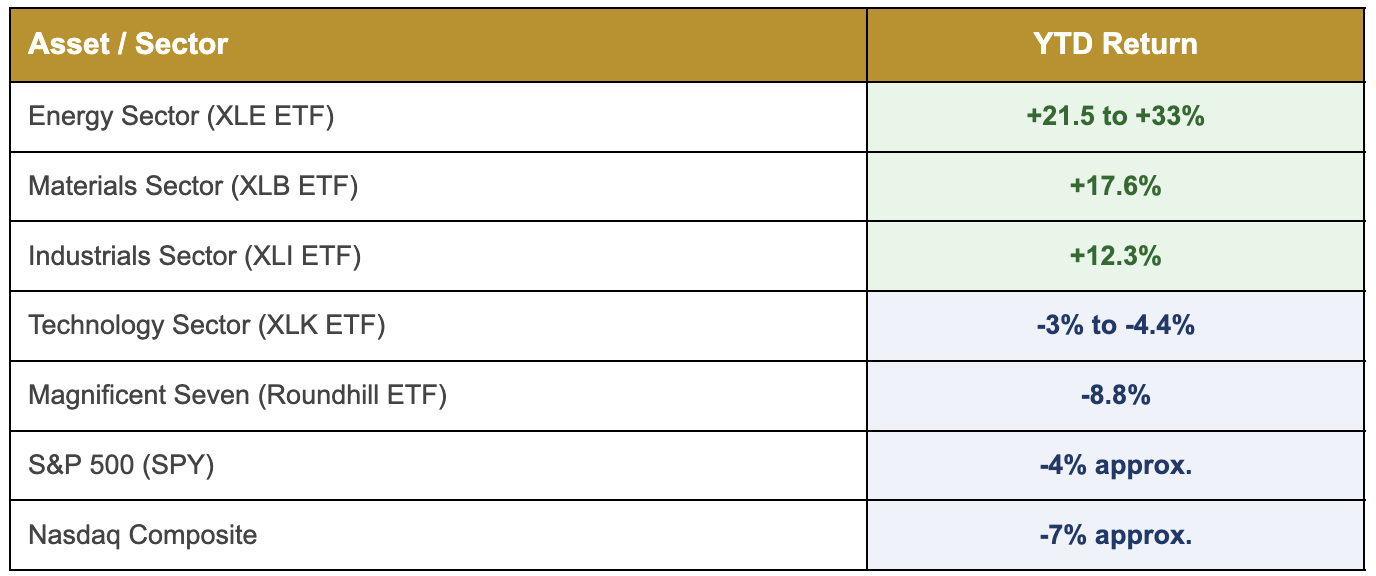
Sources: Morningstar, Motley Fool, FinancialContent — as of late March 2026

THE CASE FOR ENERGY’S DOMINANCE

The numbers don’t lie. Energy has surged to the top of the sector leaderboard in 2026 by a margin that analysts describe as historically significant. At its peak, the gap between the best and worst performing sectors reached over 24 percentage points. This key point signifies more than just a routine sector rotation.

Several powerful forces are converging to fuel this movement. Firstly and most visibly, geopolitics. The detention of Venezuelan President Nicolás Maduro in January 2026 fundamentally altered the calculus for major oil companies. Venezuela sits on the world’s largest proven oil reserves — an estimated 19.4 billion barrels, or roughly a fifth of global reserves. The prospect of ExxonMobil and Chevron gaining renewed access to that supply has sent both stocks sharply higher, and broader energy sentiment with them.

Simultaneously, rising U.S.-Iran tensions have injected a risk premium into global crude oil prices, providing further uplift to the sector. In a world where energy security has become a national priority across Western capitals, traditional fossil fuel companies are no longer the politically unfashionable trade they were in the ESG-obsessed years of the early 2020s.

Beyond geopolitics, there is a compelling valuation argument. After years of underperformance, gaining just 6.7% and 7.6% in the years of 2023 and 2024 respectively, energy stocks entered 2026 looking deeply undervalued relative to their cash flow generation. Companies like ExxonMobil and Chevron were producing record free cash flow and returning billions to shareholders via buybacks and dividends. With the average energy stock offering a dividend yield of 3–5% against the sub-1% yield typical of the technology sector, income investors faced a straightforward mathematical choice.

In an era of sticky inflation and geopolitical instability, the market is increasingly rewarding businesses that make and move real things.

WHY TECH MAY BE DOWN BUT FAR FROM OUT

For all the drama of the rotation trade, a significant body of analysis urges caution before declaring tech dead. The most measured observers on Wall Street note that what we are seeing may be a cyclical correction in an overcrowded trade rather than a permanent regime chang

Technology’s fundamentals remain robust, even if its stock prices are struggling. Analysts at Morgan Stanley point out that, unlike the dot-com era, today’s market leaders are generating substantial real profits. Nvidia, Microsoft, Alphabet, and Meta are not unprofitable hype machines; they are among the most cash-generative businesses in corporate history. Revenue growth of 15% or more is expected across the sector for 2026, and profit margins remain the envy of virtually every other industry.

Goldman Sachs’s chief equity strategist argues that the rapid appreciation in tech valuations during 2023-2025 was underpinned by genuine and sustained profit growth. Therefore, the forward price-to-earnings multiples remain modest compared to the excesses of the late 1990s. Meanwhile, Morgan Stanley has described fears of an AI bubble as “misplaced” or “premature,” pointing to the fact that the median cash flow and capital reserves of the top 500 U.S. firms are roughly triple those seen during historical bubble periods.

Bullish investors also point to what happens when the AI buildout matures. The current phase is capital-intensive and speculative. But the next phase, when enterprises start to monetise AI at scale, is expected to drive an entirely new wave of software revenue. Companies that look expensive today on AI spending may look very cheap in three years when those revenues begin to materialise.

There is also a counterargument on energy itself. The sector’s history is one of violent swings. Energy fell 33% in 2020 and was one of the worst-performing sectors for years. A de-escalation of Middle East tensions or a surge in U.S. domestic production could quickly deflate the commodity price tailwind.

Energy’s dividend appeal, while real, also needs context. In a higher-for-longer interest rate environment, investors can earn attractive yields in bonds without the commodity price volatility of the energy sector.

NEITHER CAMP HAS THE RIGHT STRATEGY

Perhaps the most neutral position in this debate is that both camps are partly right and that the binary framing of each party is missing the real story of 2026.

What is almost certainly true is that the era of indiscriminate tech buying is over. The market is now demanding differentiation. As one leading strategist put it, investors in ETFs have typically not distinguished between companies with a product but no business model, those burning cash on AI infrastructure, and those positioned to be the recipients of AI spending. That is changing fast.

Within tech itself, the picture is fragmented. Hardware names tied to AI infrastructure (particularly storage and semiconductor players) have held up far better than SaaS companies or AI platform spenders like Oracle, whose bond yields have drifted into junk territory despite its investment-grade rating. The winners and losers are being sorted by the market with increasing precision.

On the energy side, the structural case is strongest not in pure-play crude oil but in energy infrastructure like pipelines, LNG terminals, and utilities underpinning AI’s insatiable power demand. Liquefied natural gas stocks have surged since the start of the Iran war, and analysts see a multi-year story in power generation that transcends the near-term noise of oil prices.

IS ENERGY WINNING IN 2026?

On the raw numbers alone, yes. Unambiguously. Energy is the best-performing U.S. sector of 2026, up somewhere between 20% and 33% depending on the time frame measured, while technology sits at the bottom of the table with losses in the low to mid single digits. The gap between them, at over 24 percentage points, is one of the widest sector dispersions on record for the year’s first quarter.

Is this a permanent regime change? The honest answer would be probably not entirely. Geopolitical tailwinds can reverse. Commodity prices are cyclical. And technology, battered but fundamentally profitable is unlikely to surrender the commanding role it has played in the global economy and financial markets for the past decade.

What 2026 is more likely representing is a healthy, long-overdue rebalancing. After years in which the median stock was left behind by a narrow band of AI megacaps, the market is broadening. Capital is being deployed more thoughtfully. The question investors must ask is not whether to own energy or technology but how much of each, and which companies within each sector have the strongest risk-adjusted cases in a world where inflation is sticky, rates are elevated, and geopolitics can shift overnight.

One thing is certain. The era of passive of unthinking megacap tech exposure as a default all-weather strategy is, at least for now, over.

Few shifts in financial markets arrive with as much force as what investors are witnessing in 2026. The Magnificent Seven (ie. Apple, Nvidia, Microsoft, Alphabet, Amazon, Meta and Tesla)  ruled the roost for years, inflating portfolios and commanding the lion’s share of the S&P 500’s weighting. But as Q1 2026 draws to a close, the script has been torn up. Energy stocks are up more than 30% year-to-date, while technology shares have retreated. The question on every portfolio manager’s lips is whether this is a genuine, structural rotation or just a temporary trade playing out amid geopolitical noise?

The debate matters enormously. Trillions of dollars in global capital hang in the balance, and the answer shapes everything from pension fund allocations to retail investor strategies. In this feature, we lay out the full case for both sides and ask whether energy’s moment in the sun is built to last.

2026 YEAR TO DATE SCORECARD

Sources: Morningstar, Motley Fool, FinancialContent — as of late March 2026

THE CASE FOR ENERGY’S DOMINANCE

The numbers don’t lie. Energy has surged to the top of the sector leaderboard in 2026 by a margin that analysts describe as historically significant. At its peak, the gap between the best and worst performing sectors reached over 24 percentage points. This key point signifies more than just a routine sector rotation.

Several powerful forces are converging to fuel this movement. Firstly and most visibly, geopolitics. The detention of Venezuelan President Nicolás Maduro in January 2026 fundamentally altered the calculus for major oil companies. Venezuela sits on the world’s largest proven oil reserves — an estimated 19.4 billion barrels, or roughly a fifth of global reserves. The prospect of ExxonMobil and Chevron gaining renewed access to that supply has sent both stocks sharply higher, and broader energy sentiment with them.

Simultaneously, rising U.S.-Iran tensions have injected a risk premium into global crude oil prices, providing further uplift to the sector. In a world where energy security has become a national priority across Western capitals, traditional fossil fuel companies are no longer the politically unfashionable trade they were in the ESG-obsessed years of the early 2020s.

Beyond geopolitics, there is a compelling valuation argument. After years of underperformance, gaining just 6.7% and 7.6% in the years of 2023 and 2024 respectively, energy stocks entered 2026 looking deeply undervalued relative to their cash flow generation. Companies like ExxonMobil and Chevron were producing record free cash flow and returning billions to shareholders via buybacks and dividends. With the average energy stock offering a dividend yield of 3–5% against the sub-1% yield typical of the technology sector, income investors faced a straightforward mathematical choice.

In an era of sticky inflation and geopolitical instability, the market is increasingly rewarding businesses that make and move real things.

WHY TECH MAY BE DOWN BUT FAR FROM OUT

For all the drama of the rotation trade, a significant body of analysis urges caution before declaring tech dead. The most measured observers on Wall Street note that what we are seeing may be a cyclical correction in an overcrowded trade rather than a permanent regime chang

Technology’s fundamentals remain robust, even if its stock prices are struggling. Analysts at Morgan Stanley point out that, unlike the dot-com era, today’s market leaders are generating substantial real profits. Nvidia, Microsoft, Alphabet, and Meta are not unprofitable hype machines; they are among the most cash-generative businesses in corporate history. Revenue growth of 15% or more is expected across the sector for 2026, and profit margins remain the envy of virtually every other industry.

Goldman Sachs’s chief equity strategist argues that the rapid appreciation in tech valuations during 2023-2025 was underpinned by genuine and sustained profit growth. Therefore, the forward price-to-earnings multiples remain modest compared to the excesses of the late 1990s. Meanwhile, Morgan Stanley has described fears of an AI bubble as “misplaced” or “premature,” pointing to the fact that the median cash flow and capital reserves of the top 500 U.S. firms are roughly triple those seen during historical bubble periods.

Bullish investors also point to what happens when the AI buildout matures. The current phase is capital-intensive and speculative. But the next phase, when enterprises start to monetise AI at scale, is expected to drive an entirely new wave of software revenue. Companies that look expensive today on AI spending may look very cheap in three years when those revenues begin to materialise.

There is also a counterargument on energy itself. The sector’s history is one of violent swings. Energy fell 33% in 2020 and was one of the worst-performing sectors for years. A de-escalation of Middle East tensions or a surge in U.S. domestic production could quickly deflate the commodity price tailwind.

Energy’s dividend appeal, while real, also needs context. In a higher-for-longer interest rate environment, investors can earn attractive yields in bonds without the commodity price volatility of the energy sector.

NEITHER CAMP HAS THE RIGHT STRATEGY

Perhaps the most neutral position in this debate is that both camps are partly right and that the binary framing of each party is missing the real story of 2026.

What is almost certainly true is that the era of indiscriminate tech buying is over. The market is now demanding differentiation. As one leading strategist put it, investors in ETFs have typically not distinguished between companies with a product but no business model, those burning cash on AI infrastructure, and those positioned to be the recipients of AI spending. That is changing fast.

Within tech itself, the picture is fragmented. Hardware names tied to AI infrastructure (particularly storage and semiconductor players) have held up far better than SaaS companies or AI platform spenders like Oracle, whose bond yields have drifted into junk territory despite its investment-grade rating. The winners and losers are being sorted by the market with increasing precision.

On the energy side, the structural case is strongest not in pure-play crude oil but in energy infrastructure like pipelines, LNG terminals, and utilities underpinning AI’s insatiable power demand. Liquefied natural gas stocks have surged since the start of the Iran war, and analysts see a multi-year story in power generation that transcends the near-term noise of oil prices.

IS ENERGY WINNING IN 2026?

On the raw numbers alone, yes. Unambiguously. Energy is the best-performing U.S. sector of 2026, up somewhere between 20% and 33% depending on the time frame measured, while technology sits at the bottom of the table with losses in the low to mid single digits. The gap between them, at over 24 percentage points, is one of the widest sector dispersions on record for the year’s first quarter.

Is this a permanent regime change? The honest answer would be probably not entirely. Geopolitical tailwinds can reverse. Commodity prices are cyclical. And technology, battered but fundamentally profitable is unlikely to surrender the commanding role it has played in the global economy and financial markets for the past decade.

What 2026 is more likely representing is a healthy, long-overdue rebalancing. After years in which the median stock was left behind by a narrow band of AI megacaps, the market is broadening. Capital is being deployed more thoughtfully. The question investors must ask is not whether to own energy or technology but how much of each, and which companies within each sector have the strongest risk-adjusted cases in a world where inflation is sticky, rates are elevated, and geopolitics can shift overnight.

One thing is certain. The era of passive of unthinking megacap tech exposure as a default all-weather strategy is, at least for now, over.