The Significance Of The Magnificent Seven

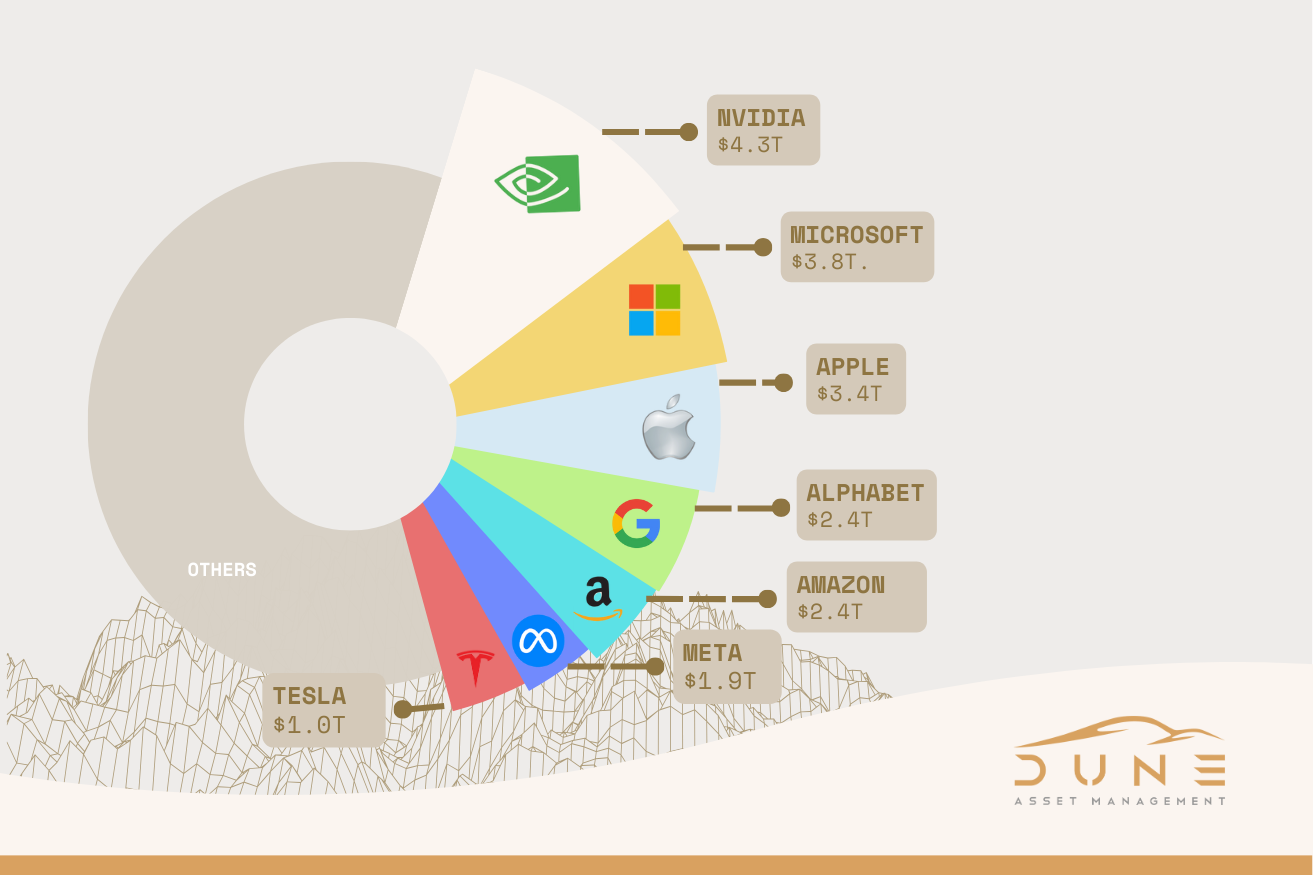
For what feels like an eternity, the investment narrative has been utterly dominated by a select few. Apple, Microsoft, Alphabet, Amazon, Nvidia, Tesla, and Meta Platforms: the formidable “Magnificent Seven.” These aren’t just companies; they’ve been market movers, sentiment shapers, and the seemingly unstoppable engines of portfolio growth. 

Their collective might has been so immense, one could almost forget there are hundreds of other publicly traded businesses out there. But as we settle into mid-2025, the plot thickens. The chorus might still be singing their praises, but a closer listen reveals some intriguing new harmonies and perhaps a few off-key notes.

Still on the Throne, But Is It a Shared Crown?

Let’s not be too quick to write their epitaph. The Magnificent Seven are not exactly fading into obscurity. Their sheer size remains staggering, still commanding a substantial chunk of the S&P 500’s market capitalisation. When these giants collectively sneeze, the market still reaches for its tissue box. And their earnings? They are undeniably still driving a significant portion of the S&P 500’s overall growth. Quarter two of 2025, for instance, projects a healthy double-digit earnings growth from this group, a performance that frankly leaves many other sectors in the dust. Institutional money, often the last to leave a party, continues to hold meaningful stakes, a testament to enduring confidence in their long-term prospects. So yes, they still sit atop the market’s hierarchy.

However, a closer look reveals a narrative far less uniform than before. The days of treating the “Magnificent Seven” as a single, unstoppable force might be drawing to a close. After an almost ridiculously strong run, particularly in 2023 and early 2024, the collective lost some of its synchronised swagger.

We’ve seen periods of notable volatility and pullbacks in early 2025. And crucially, their individual performances have begun to diverge. While Nvidia, Microsoft, and Meta continue to defy gravity with impressive gains, others are facing a stiffer headwind. Apple and Tesla, in particular, have notably lagged, seeing their share prices dip year-to-date. Tesla, for example, is grappling with fierce competition in the EV space and shifting consumer preferences, leading some market watchers to even contemplate a new lineup, perhaps swapping Tesla for a rising star like Broadcom.

This isn’t just a minor blip; it signifies a maturing of the narrative. Investors are now scrutinising individual company fundamentals, business models, and competitive landscapes, rather than simply buying the “Mag 7” basket blindly. The “Magnificent” descriptor, it seems, might no longer apply equally to all seven members.

AI: The Engine, But Also the Great Democratiser?

Artificial intelligence remains a potent, almost mystical, force driving investment. And undeniably, companies like Microsoft, Amazon, Alphabet, and Meta are throwing colossal sums at AI infrastructure. Nvidia, of course, sits squarely at the heart of this revolution, its chips the literal brains of the operation. This isn’t just hype; it’s a profound technological shift demanding immense investment. However, a fascinating dynamic is emerging. While these seven are leading the charge, AI’s transformative power isn’t confined to their walled gardens. There’s a growing sense that the AI trade will broaden. This means more opportunities for companies providing supporting roles: the specialised semiconductors, the power management solutions, the data centre infrastructure providers, and the cybersecurity firms protecting the whole digital edifice. The AI wave might have originated from the “Mag 7,” but it’s now creating ripples across the entire market, potentially democratising the gains beyond this exclusive club.

Clouds on the Horizon and the Allure of the Underdog

No reign lasts forever without its challenges. The projected earnings growth for the Magnificent Seven in 2025, while still healthy, is a deceleration from their previous breakneck pace. And here’s the rub: they still trade at a significant premium to the rest of the market. The premium pricing assumes continued, stratospheric growth. Any stumble, any disappointment, could lead to a less-than-magnificent tumble.

Then there’s the ever-present spectre of regulatory scrutiny. Antitrust probes, data privacy concerns, and geopolitical tensions (especially between the U.S. and China, impacting everything from chip exports to market access) are constant headaches. These aren’t just minor irritations; they represent genuine business risks. For investors, the sheer concentration of market wealth in these few names also presents a portfolio risk. Diversification, that old investment adage, feels particularly wise in this climate.

And this leads us to the most exciting potential development: the rise of the rest. Optimistic forecasts suggest that the earnings growth of the “S&P 493” (that’s the S&P 500 minus the Magnificent Seven) is set to accelerate, possibly catching up to, or even surpassing, their celebrated counterparts by early 2026. While this may seem like wishful thinking; it actually signals a potential shift towards broader market leadership. Investors, tired of chasing increasingly expensive growth, might finally start looking for value and untapped potential in sectors that have long played second fiddle.

The Curtain Call (Or Just an Intermission)?

So, are the Magnificent Seven still relevant? Absolutely.

They remain titans of industry, innovators, and significant drivers of overall market performance. But their narrative is undeniably evolving. The monolithic “Mag 7” trade is giving way to a more discerning approach, where individual merits and challenges take precedence. The AI wave, while empowering them, is also spreading its benefits more widely. And perhaps most intriguingly, the rest of the market, the “S&P 493,” is stirring, poised for its moment in the sun.

The question isn’t whether they’re magnificent, but for whom, and for how much longer will they hold their seemingly iron grip on the market’s imagination? The stage is set for a truly fascinating second half of 2025.

For what feels like an eternity, the investment narrative has been utterly dominated by a select few. Apple, Microsoft, Alphabet, Amazon, Nvidia, Tesla, and Meta Platforms: the formidable “Magnificent Seven.” These aren’t just companies; they’ve been market movers, sentiment shapers, and the seemingly unstoppable engines of portfolio growth. 

Their collective might has been so immense, one could almost forget there are hundreds of other publicly traded businesses out there. But as we settle into mid-2025, the plot thickens. The chorus might still be singing their praises, but a closer listen reveals some intriguing new harmonies and perhaps a few off-key notes.

Still on the Throne, But Is It a Shared Crown?

Let’s not be too quick to write their epitaph. The Magnificent Seven are not exactly fading into obscurity. Their sheer size remains staggering, still commanding a substantial chunk of the S&P 500’s market capitalisation. When these giants collectively sneeze, the market still reaches for its tissue box. And their earnings? They are undeniably still driving a significant portion of the S&P 500’s overall growth. Quarter two of 2025, for instance, projects a healthy double-digit earnings growth from this group, a performance that frankly leaves many other sectors in the dust. Institutional money, often the last to leave a party, continues to hold meaningful stakes, a testament to enduring confidence in their long-term prospects. So yes, they still sit atop the market’s hierarchy.

However, a closer look reveals a narrative far less uniform than before. The days of treating the “Magnificent Seven” as a single, unstoppable force might be drawing to a close. After an almost ridiculously strong run, particularly in 2023 and early 2024, the collective lost some of its synchronised swagger.

We’ve seen periods of notable volatility and pullbacks in early 2025. And crucially, their individual performances have begun to diverge. While Nvidia, Microsoft, and Meta continue to defy gravity with impressive gains, others are facing a stiffer headwind. Apple and Tesla, in particular, have notably lagged, seeing their share prices dip year-to-date. Tesla, for example, is grappling with fierce competition in the EV space and shifting consumer preferences, leading some market watchers to even contemplate a new lineup, perhaps swapping Tesla for a rising star like Broadcom.

This isn’t just a minor blip; it signifies a maturing of the narrative. Investors are now scrutinising individual company fundamentals, business models, and competitive landscapes, rather than simply buying the “Mag 7” basket blindly. The “Magnificent” descriptor, it seems, might no longer apply equally to all seven members.

AI: The Engine, But Also the Great Democratiser?

Artificial intelligence remains a potent, almost mystical, force driving investment. And undeniably, companies like Microsoft, Amazon, Alphabet, and Meta are throwing colossal sums at AI infrastructure. Nvidia, of course, sits squarely at the heart of this revolution, its chips the literal brains of the operation. This isn’t just hype; it’s a profound technological shift demanding immense investment. However, a fascinating dynamic is emerging. While these seven are leading the charge, AI’s transformative power isn’t confined to their walled gardens. There’s a growing sense that the AI trade will broaden. This means more opportunities for companies providing supporting roles: the specialised semiconductors, the power management solutions, the data centre infrastructure providers, and the cybersecurity firms protecting the whole digital edifice. The AI wave might have originated from the “Mag 7,” but it’s now creating ripples across the entire market, potentially democratising the gains beyond this exclusive club.

Clouds on the Horizon and the Allure of the Underdog

No reign lasts forever without its challenges. The projected earnings growth for the Magnificent Seven in 2025, while still healthy, is a deceleration from their previous breakneck pace. And here’s the rub: they still trade at a significant premium to the rest of the market. The premium pricing assumes continued, stratospheric growth. Any stumble, any disappointment, could lead to a less-than-magnificent tumble.

Then there’s the ever-present spectre of regulatory scrutiny. Antitrust probes, data privacy concerns, and geopolitical tensions (especially between the U.S. and China, impacting everything from chip exports to market access) are constant headaches. These aren’t just minor irritations; they represent genuine business risks. For investors, the sheer concentration of market wealth in these few names also presents a portfolio risk. Diversification, that old investment adage, feels particularly wise in this climate.

And this leads us to the most exciting potential development: the rise of the rest. Optimistic forecasts suggest that the earnings growth of the “S&P 493” (that’s the S&P 500 minus the Magnificent Seven) is set to accelerate, possibly catching up to, or even surpassing, their celebrated counterparts by early 2026. While this may seem like wishful thinking; it actually signals a potential shift towards broader market leadership. Investors, tired of chasing increasingly expensive growth, might finally start looking for value and untapped potential in sectors that have long played second fiddle.

The Curtain Call (Or Just an Intermission)?

So, are the Magnificent Seven still relevant? Absolutely.

They remain titans of industry, innovators, and significant drivers of overall market performance. But their narrative is undeniably evolving. The monolithic “Mag 7” trade is giving way to a more discerning approach, where individual merits and challenges take precedence. The AI wave, while empowering them, is also spreading its benefits more widely. And perhaps most intriguingly, the rest of the market, the “S&P 493,” is stirring, poised for its moment in the sun.

The question isn’t whether they’re magnificent, but for whom, and for how much longer will they hold their seemingly iron grip on the market’s imagination? The stage is set for a truly fascinating second half of 2025.