
South Korea’s latest economic rebound is increasingly looking less like a broad-based recovery and more like a semiconductor-led rerating. At the centre of that shift are Samsung Electronics and SK hynix, whose earnings momentum has been lifted by the AI-driven memory cycle, stronger export volumes, and firmer global pricing.
What has sharpened the story in recent months is the meteoric rise of SK hynix. The company has emerged as the clearest winner from AI memory demand, with its share price and market capitalisation surging over 1,700 trillion Korean won as investors rewarded its stronger exposure to high-bandwidth memory and the broader upcycle in advanced chips.
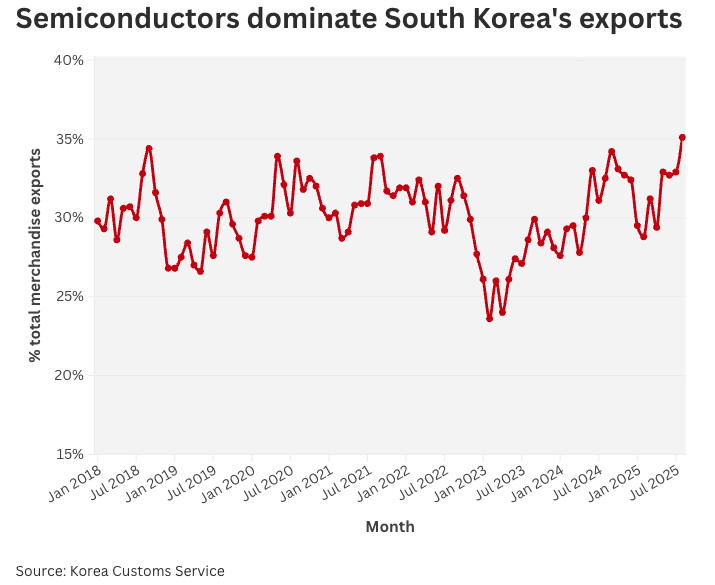
That rally has not just been a stock-specific move; it has become a macro signal. Thoroughly reinforcing the idea that South Korea’s growth and market performance are being pulled by the “K-semiconductor strategy” rather than by domestic demand.
The macro implications are also significant.
A stronger chip upcycle has significantly boosted corporate profits. Starting by improving South Korea’s trade balance, supporting industrial production, and even helping to push growth above expectations at a time when domestic demand remains uneven.
In effect, the chip complex has become the key transmission channel through which the global AI capex boom is feeding into the Korean economy.
That concentration is now visible across markets.
Samsung and SK hynix have been major drivers of KOSPI gains, reinforcing how tightly Korea’s equity performance is linked to the semiconductor cycle. For investors, SK hynix’s rapid ascent matters because it shows the market is willing to reprice Korea as an AI supply-chain beneficiary and not just a mature manufacturing economy.
The risk, of course, is that this recovery is narrow. Korea is benefiting from an external demand shock in semiconductors, but that also leaves the economy exposed if AI spending moderates, memory prices normalise, or geopolitical and supply-chain disruptions hit output.
This is certainly not an argument against South Korea’s semiconductor industry.
Rather, we believe that South Korea’s dominance in this space is a result of decades of targeted policy, corporate ambition, and technical excellence. With SK hynix’s meteoric rise underscoring how quickly markets can rewrite the country’s macro narrative, we will surely be keeping a close eye on what’s to come.