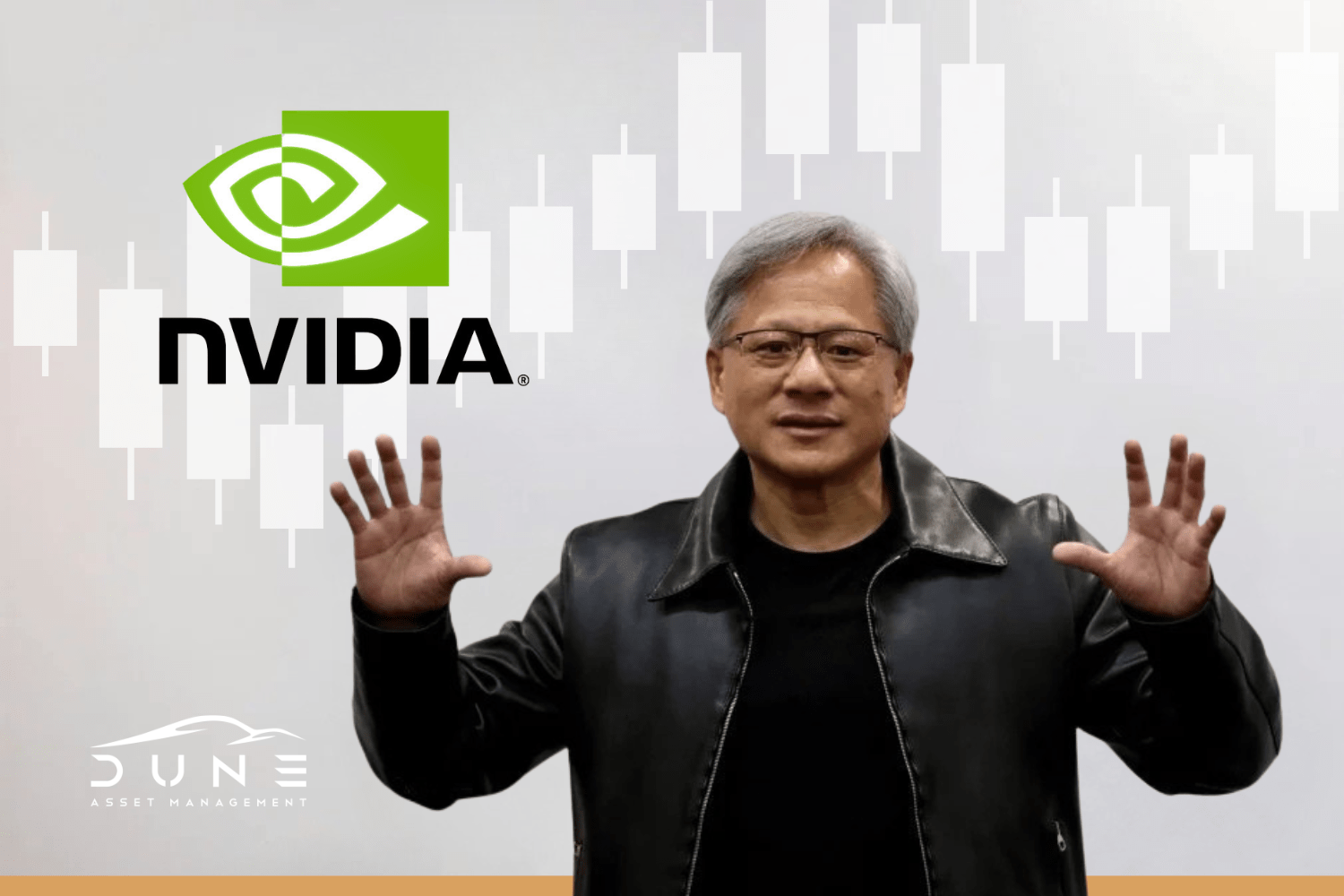
Earnings Season, Redefined by Nvidia

Nvidia has become many things to the market. A chip designer, certainly. A proxy for artificial intelligence, undoubtedly. But perhaps most importantly, Nvidia has evolved into something far larger than its own balance sheet. It is now a barometer for risk appetite across global equities.

That helps explain why its earnings releases are no longer just corporate updates. They are market-moving events.

At the heart of this phenomenon is Nvidia’s unique positioning in the AI value chain. Unlike previous technology cycles, where demand was dispersed across multiple players, the current AI buildout is unusually concentrated. Nvidia sits at the centre of it, supplying the GPUs that power everything from large language models to data centre expansion. When Nvidia reports, it is effectively revealing the pace of AI infrastructure investment worldwide.

This creates a powerful signalling effect. Strong earnings and forward guidance are interpreted as confirmation that hyperscalers are still spending aggressively, that enterprise adoption is accelerating, and that the AI narrative remains intact. Weakness, on the other hand, raises uncomfortable questions about whether expectations have run ahead of reality.

Markets, being forward-looking, react accordingly.

There is also a mechanical dimension to Nvidia’s influence. Its sheer size means it carries significant weight in major indices such as the S&P 500 and Nasdaq. More importantly, it dominates the performance of the “Magnificent Seven,” which collectively account for an outsized share of index returns. When Nvidia moves, passive flows, ETFs, and benchmarked portfolios move with it. This amplifies its impact beyond what fundamentals alone might justify.

But the real story lies in sentiment transmission.

Nvidia’s earnings act as a litmus test for one of the market’s most crowded trades: the belief that AI will drive a sustained earnings supercycle. When Nvidia delivers upside surprises, it reinforces this narrative, lifting not just semiconductors but adjacent sectors including cloud computing, software, and even power infrastructure. The rally broadens because the story feels validated.

Conversely, any disappointment tends to trigger a more systemic reaction. Investors begin to question valuations, positioning unwinds, and what starts as a single-stock reaction can quickly cascade across sectors. In that sense, Nvidia does not just report earnings. It resets expectations.

There is a certain irony in all this. Nvidia’s fundamentals remain extraordinary, but the market’s reaction to its results often says more about positioning than performance. Expectations are now so elevated that even strong numbers can disappoint if they fail to clear an ever-rising bar.

This is what turns Nvidia earnings into a market event rather than a company update.

In previous cycles, investors looked to macro data or central bank signals to gauge direction. Today, a significant portion of that role has been outsourced to a single company at the forefront of the AI revolution. Nvidia has become, for better or worse, a real-time indicator of whether the market’s most important narrative is still holding together.

And for now, that narrative is doing much of the heavy lifting.