
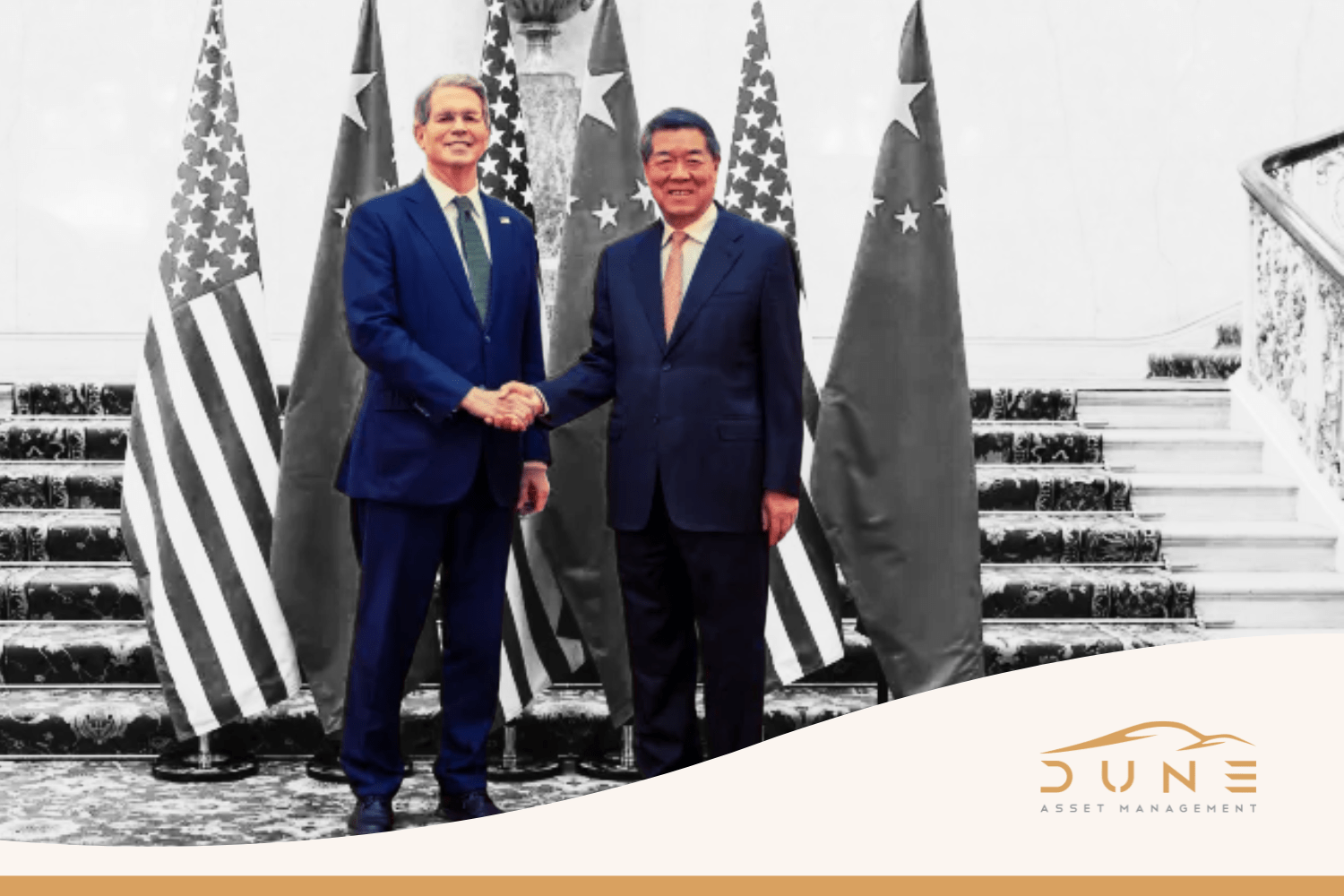
The latest round of China–USA trade talks in London has taken centre stage for global investors, who are keenly attuned to any developments that might signal either progress or renewed tension between the world’s two largest economies. The talks concluded with a tentative truce and mutual commitments to revive previous agreements, sparking a wave of cautious optimism across financial markets. However, the discussions also highlighted the persistent uncertainties that continue to shape the investment landscape.
Equity markets responded positively to early indications of de-escalation. Major U.S. indices such as the S&P 500 and Nasdaq 100 climbed to multi-month highs, while the Dow Jones Industrial Average also posted gains, reflecting investor relief at the prospect of improving bilateral relations. Asian markets, particularly those outside Japan, maintained their upward momentum, with the MSCI Asia-Pacific index advancing modestly. This broad-based rally suggests that investors are encouraged by the prospect of a pause in hostilities, even if only temporary.
Currency markets also reflected this mood of cautious optimism. The U.S. dollar edged higher, and China’s yuan remained stable, signalling that currency traders welcomed the truce but remained wary of lingering risks. Meanwhile, the talks brought renewed attention to key sectors such as rare earth minerals and semiconductors. There is growing optimism that the U.S. may ease export restrictions on high-end chips in exchange for China lifting curbs on rare earth exports—developments that could have significant implications for industries ranging from automotive to technology.
Despite the positive market response, it is important to note that the outcome of the talks amounted to a temporary truce rather than a comprehensive resolution. Both sides pledged to revive a previous agreement and to roll back some export restrictions, particularly around rare earths, which have been a major sticking point in recent negotiations. However, the lack of detailed commitments left many investors seeking more clarity. As Chris Weston of Pepperstone observed, “the muted market response indicates that this outcome was largely anticipated.” In other words, while the risk of an immediate escalation has receded, markets remain acutely aware of the underlying uncertainties.
The prospect of further tariff relief has also buoyed sentiment, particularly among companies that have been directly affected by earlier trade tensions. Nevertheless, the broader macroeconomic backdrop remains fragile. The World Bank’s recent downgrade of its global GDP forecast, which cited ongoing trade uncertainty as a key factor, serves as a reminder that the global economy is still navigating a challenging environment.
The prospect of further tariff relief has also buoyed sentiment, particularly among companies that have been directly affected by earlier trade tensions. Nevertheless, the broader macroeconomic backdrop remains fragile. The World Bank’s recent downgrade of its global GDP forecast, which cited ongoing trade uncertainty as a key factor, serves as a reminder that the global economy is still navigating a challenging environment.
Looking ahead, investors should recognise that while the constructive tone of the talks has provided short-term relief, long-term uncertainty persists. Without concrete, enforceable agreements, the current optimism may prove fleeting. The risk of renewed tariff flare-ups and policy reversals continues to weigh on market sentiment. Companies in sectors directly affected by tariffs and export controls, such as technology, automotive, and manufacturing, will remain particularly sensitive to further developments. Any substantive deal on semiconductors and rare earths could trigger sector-specific rallies, but until such agreements are finalised, volatility is likely to persist.
Finally, investors will be closely watching upcoming U.S. inflation data and other global macroeconomic indicators for further direction. These data points will play a crucial role in shaping central bank policy and overall risk appetite in the wake of the talks.
In conclusion, the latest China–USA trade talks have provided markets with a welcome pause in hostilities and a foundation for further negotiation. However, the absence of detailed, binding commitments means that uncertainty will continue to cast a shadow over the investment landscape. Investors are advised to remain vigilant, balancing cautious optimism with prudent risk management as the situation continues to evolve.