
I read Kevin Muir’s latest musings over the weekend, and that tipped me over from a hunch I’ve been having about Gold and Silver. Muir’s post was originally inspired by a recent podcast interview that another modern-day value legend, David Einhorn, gave [THE LONG AND SHORT OF INVESTING with David Einhorn], and now we are doing a derivative post on top of these fellas. In Muir’s letter, he artfully summed up the situation in Gold and Silver by drawing parallels to the “Tepper Trade of 2010 — Long Equities”. Here’s the snippet from the post:
“
One of my all-time favourite hedge fund managers is Appaloosa’s David Tepper. He is an absolutely fantastic risk taker. If there was any doubt about his status in the trader’s Hall of Fame, it was solidified in September 2010 when he got on CNBC and made one of the calls of the decade.
Let me set the stage; after getting annihilated by 58% between late 2007 and the March 2009, the S&P 500 had rallied 600 points off the lows, but had stalled. Most traders were skeptical, expecting the market to roll back over. But not, David.
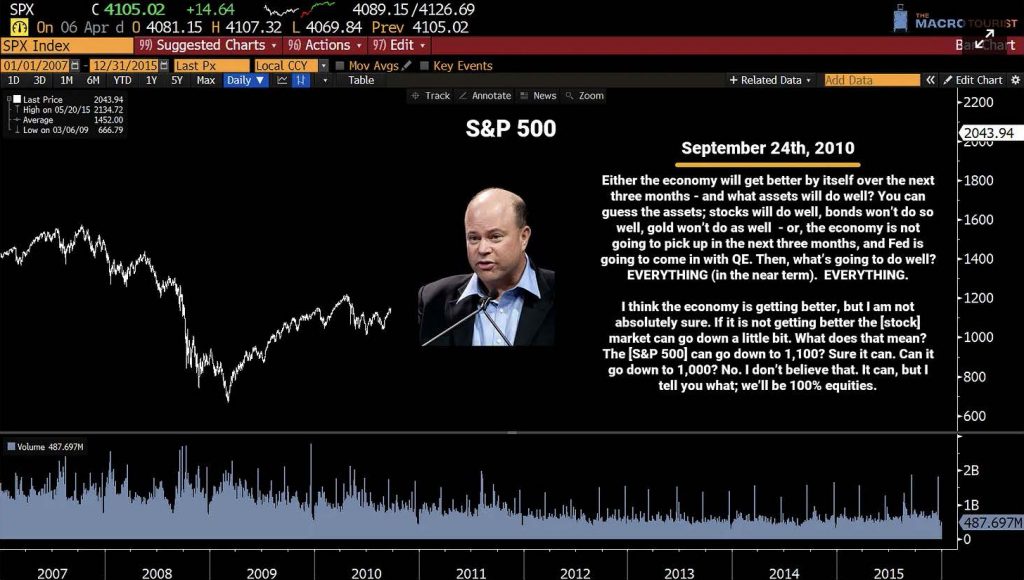
Tepper: Either the economy will get better by itself over the next three months — and what assets will do well? You can guess the assets; stocks will do well, bonds won’t do so well, gold won’t do as well — or, the economy is not going to pick up in the next three months, and Fed is going to come in with QE. Then, what’s going to do well? EVERYTHING (in the near term). EVERYTHING.
I think the economy is getting better, but I am not absolutely sure. If it is not getting better, the [stock] market can go down a little bit. What does that mean? The [S&P 500] can go down to 1,100? Sure it can. Can it go down to 1,000? No. I don’t believe that. It can, but I tell you what; we’ll be 100% equities.
In hindsight, this seems obvious, but let me assure you; at the time, it was anything but!
O’Shaughnessy: It is really interesting to think about portfolio positioning; even something like gold (which I have seen you talk about within the last year), how do you think about an asset like that? Or assets that become more relevant in a macro backdrop like the one we are facing today?
Einhorn: I did a talk about gold (I suspect that you’re referring to last year’s Sohn Conference), and essentially the point I was making was that at some point, there was going to be the war to fight inflation and it was going to run into a concern about financial stability—whether it is funding the government or some other course related to financial stability, and now we are about nine or ten months later, and that’s exactly what’s happened. We’re at that point right now where fighting inflation has to be traded off against financial stability. And you see that gold has done pretty well for the last few weeks since the Silicon Valley Bank situation, to the extent that the Fed has to choose financial stability over raising rates, then gold is likely to do well.
”
Tepper of 2010 purported that Long Equities into what seemed like a dicey environment was a “Perfect Trade” because all foreseeable outcomes led to higher equity prices. In today’s case, we see that in Gold & Silver, and as closely linked byproducts, Long-Dated bonds. The following points are the line of thoughts we are treading:
1.
Fed is at a point where incremental hikes are at risk of breaking stuff. Einhorn argued that the easy part of the Fed raising rates is in the rear-view mirror. When the Fed raised from 0% to 1%, there was little worry that it would cause financial stress on regional banks. However, the same can’t be said for the move from 5% to 6%. This implies that the days of rate hikes are numbered.
2.
Front-End rates are currently much more sensitive than the Long-End. At the risk of hot numbers coming in, higher inflation will lead to higher front-end rates, increasing the risk of recession, which puts a lid on the rate for the long end. Alternatively, if inflation comes off, markets are more eager to price in rate cuts across the curve, and long-end DV01 (Dollar Value of a basis point) will create better conditions for capital increase. The path of least resistance for rates across the curve is to the downside (reiterate point 1.). In this case, long-dated bonds (TLT) are setting up to be a great trade with little downside risk and good convexity based on DV01. In addition, this position is more strategic rather than tactical, as explained in the next point.
3.
Gold/Silver is more sensitive to Front-End rates. In the current situation, as described in point 2, positioning for the top in Front-End is more tactical due to higher volatility and response towards immediate data. In contrast, the Long-End is pretty much capped at this point. Given this predisposition, Long TLT should be a strategic position and Gold/Silver a tactical overlay when we believe the top in the Front-End is nigh.
4.
Gold/Silver Decoupling from TIPS.
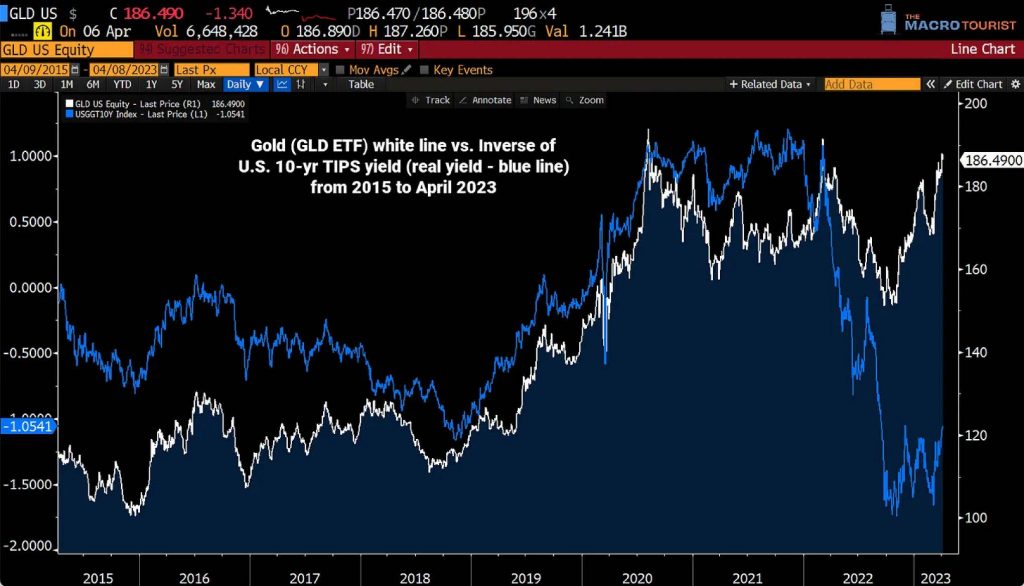
If we juxtapose Gold/Silver against TIPS, Gold/Silver was rather nonchalant and traded much more constructively. This is another critical marker.
Critical Markers:
Bank loan contraction worst Than 2008. Say what you like, but the real-economy is a derivative of banking credit activity.
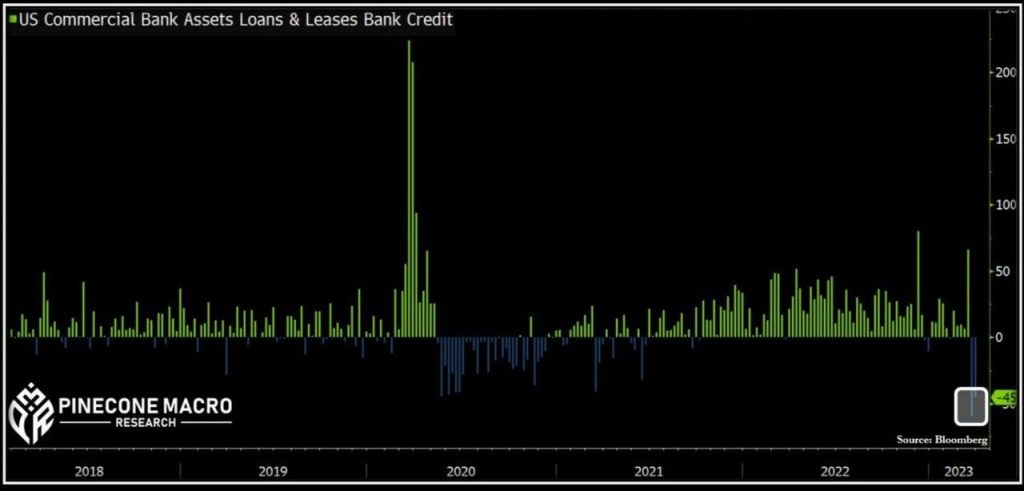
Started from the bottom now we here.
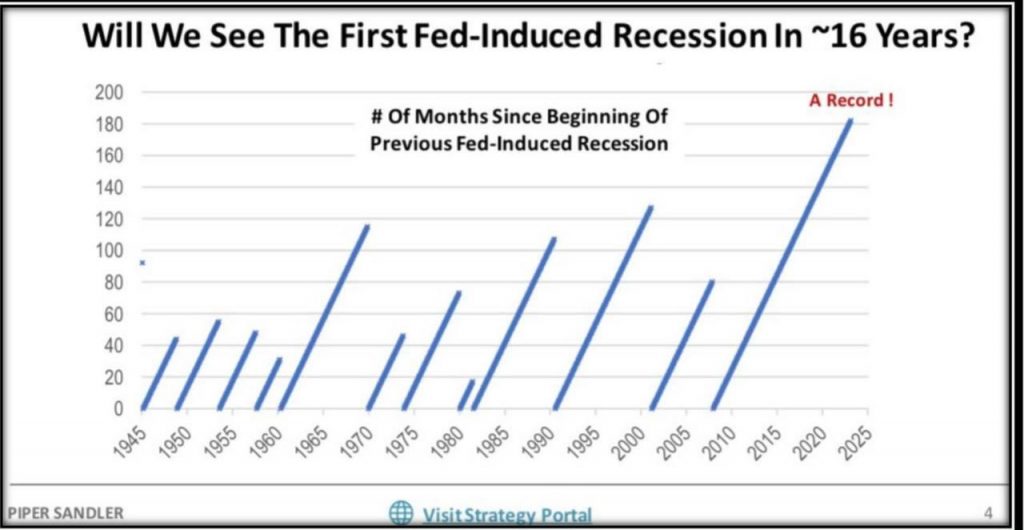
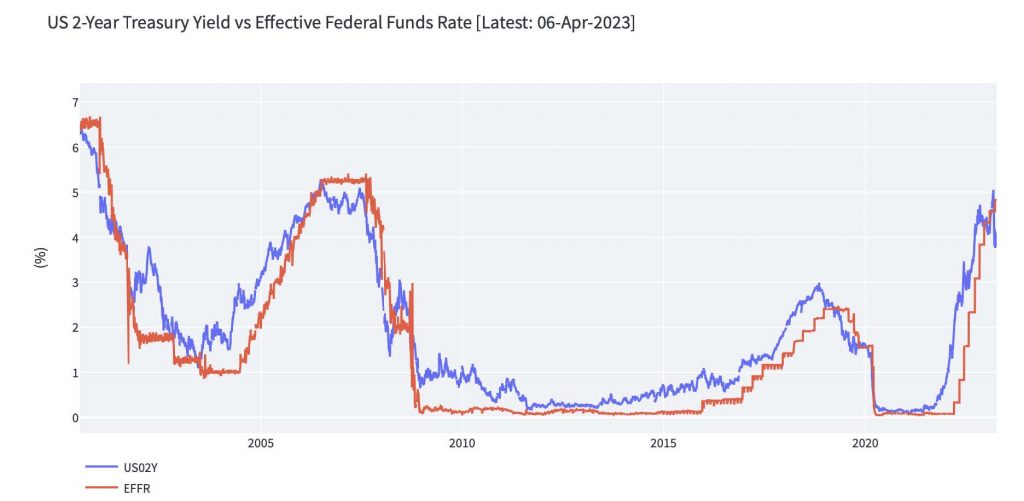
Each time 2yr US rate dips below Fed Funds Rate, it signals a top. This time shouldn’t be different.
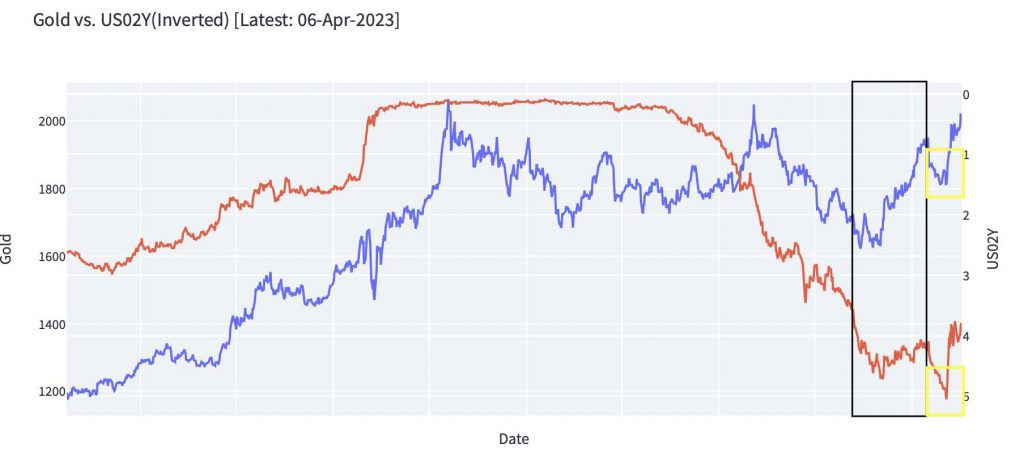
Gold started to decouple from 2yr rates, as shown in the black box. Highlighted in the Yellow boxes is Gold making a higher low vs 2yr rates, which made a lower low. These incidents seal a high probability setup for the beginning of a new bull market in Gold.