

“The solidarity of the classical vision of the world is nothing other than our own myopia. The certainties of classical physics are just probabilities. The well-defined and solid picutre of the world given by the old physics is an illusion.”
– Carlo Rovelli, Heldoland: The World of Quantum Theory.
The fading ability for Logical & Lexical semantics has caused the masses to be easy prey for curated or mainstream narratives, the devil’s in the details, and most are too cognitively paralyzed to think deeper about stuff. Concurrent Alternate Realities are a state describing the possibility that reality, when fractalized (nuanced), reveals that the all-encompassing narrative masks what is truly going on beneath the surface (crosscurrents & undercurrents). We pass terms like “Soft-landing”, “Hard-landing”, and “Recession”, but what do they really mean? I believe that overarching representations and narratives will be highly misleading and dangerous to latch onto in the age of discourse. Generaliztion works in times of peace and stability, while states of high entropy (chaos) require clear eyes and a full heart. Out of discourse will birth economic factions, and economic factors will birth commodity encumbrance, which reroutes capital flows, creating concurrent divergent economies and market states.
Things That Caught Our Attention
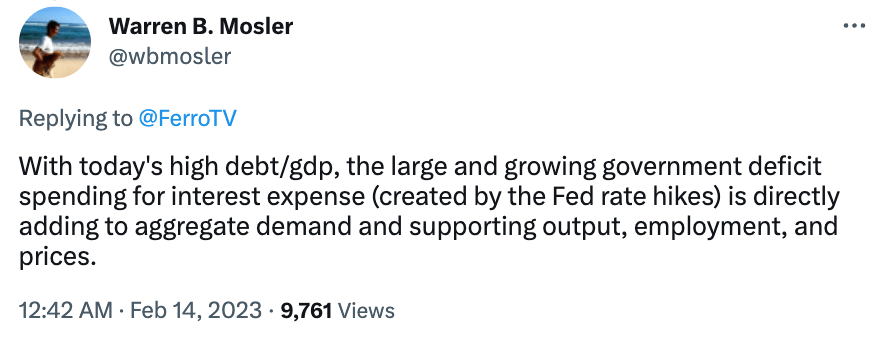
Warren Mosler is one of if not the foremost global experts on Modern Monetary Theory (MMT), which requires him to understand monetary flows extremely well.
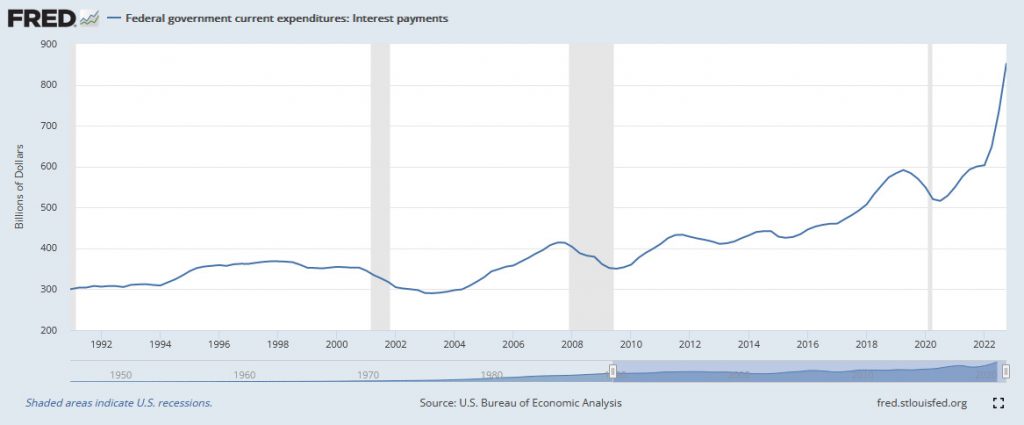
An oxymoron to ponder. Higher rates are driving higher interest expenses and, therefore, and extra $300B+ in what is essentially Federal stimulus (UST interest) injected into the economy. Since the US government is NOT reducing another spending to afford its interest, the interest is essentially an extra 1.2% of GDP injected into the economy ($26 trillion/$300B).
Add in the $200-300B the Fed is essentially printing out of thin air to pay interest on reserves and RRP balances, and we are starting to talk about real stimulus: $500-600 billion, bled into the real economy either already or in the future via Federal deficits.
Realtime commodity encumbrance. Two weeks ago, GM bought a lithium mine. Last week, Volvo announced it was looking at vertically integrating its EV supply chain and purchasing equity interest in mines as well. This week, we have LG Chem’s CEO saying something significant: “Supply is more important than the price.”
This is obviously bullish for EV metals prices and energy commodities more broadly. However, there is a much bigger read-through here in our view: “Supply is more important than the price” is another description of hyperinflation (“I don’t care about the price, just swap this cash for the physical good or goods in question.”)
We have seen Zoltan Pozsar take some guff about his “commodity reserves” > “UST reserves” point. Still, here again, for the third straight week, we have a major global corporation with skin in the game openly stating by their actions (and in case above, also their words) that Zoltan is right and his detractors are wrong. Bigger picture, we are watching a 40+-year relationship break down whereby one did not need to stockpile commodities because stockpiling USTs or USDs was essentially the same thing. Peak Cheap Energy and Commodities are turning this on its head.
What you don’t see. Since we are on the topic of paradigm subversion and questioning the real meaning of what we perceive to be accurate, the question begets, is the premium we are paying for western democracy really worth it at this point? When the very fabric of democracy is waning rapidly in light of things.
In the context of traditional energy markets, western economies toying with the idea of windfall taxes and coercive measures to make life difficult for the industry is no different from policies in populist economies. However, these companies still trade at much richer valuations compared to the “known evils” of their populist and socialist peers. In contrast, one is priced for maximum hopium, where there is only downside, and the other is priced for maximum depression. As discussed before in the realigning of economic factions and flow of capital, populist and socialist countries now have different incentives, and many of them have commodity champions (Brazil – Petrobras, Colombia – Ecopetrol, Kazakhstan – Kazatomprom) which can help them succeed in the age of commodity encumbrance.