
The Atomic Comeback

Blog Article Cover Image featuring a nuclear reactor

In the world of energy, few things command as much attention as a good comeback story. We have seen oil reinvent itself, natural gas as a “bridge fuel,” and renewables dominate headlines. But the latest act belongs to an old-school player: Nuclear Power. It’s no longer a relic of the Cold War or a footnote in the climate debate. With the relentless demand from AI and data centres driving a new need for reliable, decarbonised electricity, nuclear is fast becoming the most compelling story in energy and commodities.

For investors, it is not a question of whether nuclear is back, but how to position for its explosive return.

The Long & Short Of It All

The signs of this resurgence are immediate and tangible. The most direct evidence can be found in the uranium market. Once a sleepy corner of the commodities world, uranium has awoken with prices more than doubling over the past five years. This is certainly not just a speculative rally; it is a direct response to utilities actively securing their long-term fuel supply and the looming spectre of a supply deficit.

This market action has created a clear divergence in the broader energy sector. While traditional fossil fuels have struggled for momentum, the nuclear value chain has soared. This is a rotation of capital in its purest form. Investors are not just dipping their toes in the water; they are diving in headfirst. We have seen formerly niche areas like uranium trading attract major players, reflecting a new level of liquidity and institutional interest. It is a clear signal that the money is betting on atomic energy.
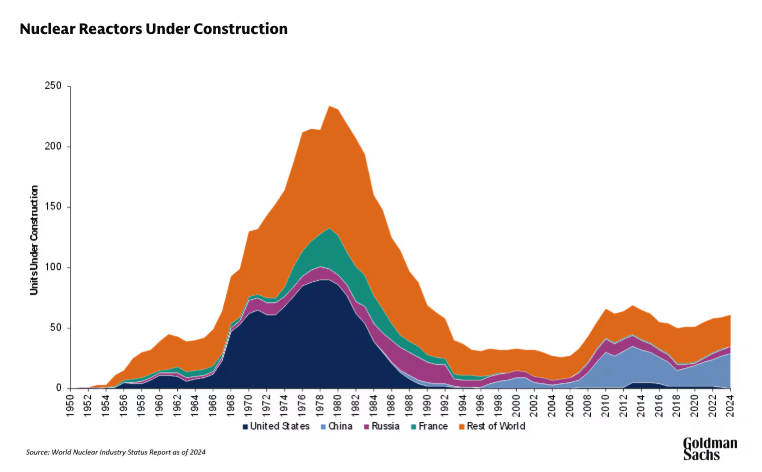
Chart demonstrating the amount of Nuclear Reactors under construction
Source: Goldman Sachs

Looking beyond the current market euphoria, nuclear’s impact promises to be generational. The International Energy Agency forecasts global nuclear output will hit record highs, driven by new builds in Asis and a policy-driven embrace in the Western market. Beyond just adding new reactors, it is about a fundamental shift in the global mix.

As nuclear secures its place as a cornerstone of clean, baseload power, it will inevitably disrupt other commodities. Thermal coals and natural gas, especially those used for continuous power generation, may see their long-term growth prospects capped. The need for a steady and reliable power source for things like data centres is shifting the equation, AI does not wait for the wind to blow or the sun. It needs power 24/7 and nuclear is the only large scale carbon-free source that can reliably deliver that.

Of course, this transformation requires vast investment. Morgan Stanley’s projection of over $2 trillion in cumulative nuclear investment is not just a number; it’s a blueprint for a massive multi-decade infrastcuture boom. This creates opportunities far beyond just uranium miners, spilling into construction, engineering, and a complex supply chain of specialised materials.

Opportunity & Risks

The nuclear trade today offers high reward but it is accompanied with a unique set of risks. The opportunities are clear with early exposure to uranium miners and nuclear engineering firms possibly leading to outsized gains. Investors can also gain access through strategic commodities like uranium-linked ETFs or physical trusts. This movement aligns with the global push for decarbonisation and offers a way to directly invest in the infrastructure of the future.

However, a sober assessment is critical as this sector is highly sensitive to policy and regulatory shifts. A simple legislative change or a reversal in public opinion could put an halt to the momentum gained. The long construction timelines and potential for costs overruns also pose a significant execution risk. And let us not forget the historical volatility of the uranium market which has seen its far share of “false starts”.

The demand for nuclear power is clearer than it has been in decades. It has developed into an essential component of the global energy transition, especially as data centres and AI become an increasingly important part of our economy. The pace at which supply & infrastructure catch up will ultimately determine how investors dare in this unfolding story.

In the world of energy, few things command as much attention as a good comeback story. We have seen oil reinvent itself, natural gas as a “bridge fuel,” and renewables dominate headlines. But the latest act belongs to an old-school player: Nuclear Power. It’s no longer a relic of the Cold War or a footnote in the climate debate. With the relentless demand from AI and data centres driving a new need for reliable, decarbonised electricity, nuclear is fast becoming the most compelling story in energy and commodities.

For investors, it is not a question of whether nuclear is back, but how to position for its explosive return.

The Long & Short Of It All

The signs of this resurgence are immediate and tangible. The most direct evidence can be found in the uranium market. Once a sleepy corner of the commodities world, uranium has awoken with prices more than doubling over the past five years. This is certainly not just a speculative rally; it is a direct response to utilities actively securing their long-term fuel supply and the looming spectre of a supply deficit.

This market action has created a clear divergence in the broader energy sector. While traditional fossil fuels have struggled for momentum, the nuclear value chain has soared. This is a rotation of capital in its purest form. Investors are not just dipping their toes in the water; they are diving in headfirst. We have seen formerly niche areas like uranium trading attract major players, reflecting a new level of liquidity and institutional interest. It is a clear signal that the money is betting on atomic energy.

Chart demonstrating the amount of Nuclear Reactors under construction
Source: Goldman Sachs

Looking beyond the current market euphoria, nuclear’s impact promises to be generational. The International Energy Agency forecasts global nuclear output will hit record highs, driven by new builds in Asis and a policy-driven embrace in the Western market. Beyond just adding new reactors, it is about a fundamental shift in the global mix.

As nuclear secures its place as a cornerstone of clean, baseload power, it will inevitably disrupt other commodities. Thermal coals and natural gas, especially those used for continuous power generation, may see their long-term growth prospects capped. The need for a steady and reliable power source for things like data centres is shifting the equation, AI does not wait for the wind to blow or the sun. It needs power 24/7 and nuclear is the only large scale carbon-free source that can reliably deliver that.

Of course, this transformation requires vast investment. Morgan Stanley’s projection of over $2 trillion in cumulative nuclear investment is not just a number; it’s a blueprint for a massive multi-decade infrastcuture boom. This creates opportunities far beyond just uranium miners, spilling into construction, engineering, and a complex supply chain of specialised materials.

Opportunity & Risks

The nuclear trade today offers high reward but it is accompanied with a unique set of risks. The opportunities are clear with early exposure to uranium miners and nuclear engineering firms possibly leading to outsized gains. Investors can also gain access through strategic commodities like uranium-linked ETFs or physical trusts. This movement aligns with the global push for decarbonisation and offers a way to directly invest in the infrastructure of the future.

However, a sober assessment is critical as this sector is highly sensitive to policy and regulatory shifts. A simple legislative change or a reversal in public opinion could put an halt to the momentum gained. The long construction timelines and potential for costs overruns also pose a significant execution risk. And let us not forget the historical volatility of the uranium market which has seen its far share of “false starts”.

The demand for nuclear power is clearer than it has been in decades. It has developed into an essential component of the global energy transition, especially as data centres and AI become an increasingly important part of our economy. The pace at which supply & infrastructure catch up will ultimately determine how investors dare in this unfolding story.