

A Golden Bet: Why Miners Are Outshining The Metal

Cover image of a gloved hand holding a nugget of gold at a gold mine

In the world of finance, few assets capture the imagination quite like gold. For centuries, it has been the ultimate safe haven, a dependable refuge from the tempests of inflation. But while gold itself has been making headlines with its record-breaking rallies, a far more compelling story is unfolding in the stock market. Gold mining companies, often seen as a volatile and risky side bet, are not just keeping up with the metal; they are leaving it in the dust.

So, why are these miners outperforming the very commodity they produce? The answer lies in a powerful economic principle known as operating leverage, a concept that turns rising gold prices into a financial rocket fuel for mining companies.

Think of a gold mining company’s balance sheet. It is filled with substantial, and largely fixed, costs: the massive machinery, the salaries of skilled workers, the energy needed to power the mine, and the expensive exploration efforts. These costs do not increase proportionally with the price of gold.

This is where the magic happens. When the price of gold rises, a miner’s revenue per ounce skyrockets. Since their costs per ounce remain relatively stable, the difference in profit margins expands at a much faster rate. A modest 10% increase in the price of gold can easily lead to a 30% or 40% jump in a company’s profit per ounce. This disproportionate increase in profitability is the secret sauce driving the outperformance of gold miners’ stocks.

Let us look at a simplified example to visualise this:
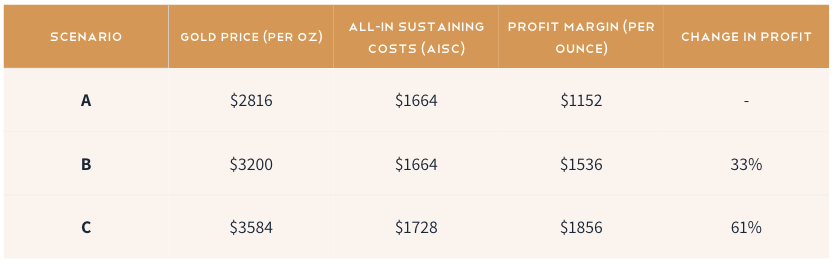
Table depicting different scenarios of gold prices in relation to mining costs & profitability.

As the table demonstrates, even with a slight bump in costs from inflation, a strong gold rally can dramatically boost a company’s bottom line. It is this powerful profitability engine that investors are clamouring to get a piece of.

For years, the gold mining sector was plagued by mismanagement, excessive debt and a reputation for being a poor investment. However, the high gold prices of recent years have acted as a powerful corrective. Miners have used their newfound profits to strengthen their financial position

This has led to a major shift:

Debt Reduction: Wherein companies are aggressively paying down debt, making them more resilient & attractive to investors.

Shareholder Returns: With stronger cash flows, many miners are now offering or increasing dividends, providing an additional stream of income thay physical gold cannot.

Increased M&A: The industry is seeing more mergers & acquisitions as companies consolidate to unlock efficiencies and create value, signalling a more mature & disciplined sector.

This newfound financial health has led investors to reassess and upgrade their views of the industry. The discount once applied to miners’ stocks due to past issues is now shrinking, as the market recognises the true value and profit potential of these companies.

While gold bullion remains an essential tool for portfolio diversification and a hedge against economic instability , gold mining stocks offer a leveraged play on that very same thesis. They allow investors to bet not just on the price of gold, but on the ability of well-run companies to turn that price into exponentially greater profits.

Of course, this increased potential comes with increased risk. Miners are subjected to company specific challenges, operational snags, and geopolitical instability. They are not the perfect, pristine store of value that a gold bar presents. Instead, for investors who believe in the long-term upward trajectory of the precious metal, the potential for a gold miner’s stock to deliver superior returns in this economy is a very compelling reason to dig a little deeper.

The real gold rush, it seems, is not happening on the ground; it is happening in the markets.

In the world of finance, few assets capture the imagination quite like gold. For centuries, it has been the ultimate safe haven, a dependable refuge from the tempests of inflation. But while gold itself has been making headlines with its record-breaking rallies, a far more compelling story is unfolding in the stock market. Gold mining companies, often seen as a volatile and risky side bet, are not just keeping up with the metal; they are leaving it in the dust.

So, why are these miners outperforming the very commodity they produce? The answer lies in a powerful economic principle known as operating leverage, a concept that turns rising gold prices into a financial rocket fuel for mining companies.

Think of a gold mining company’s balance sheet. It is filled with substantial, and largely fixed, costs: the massive machinery, the salaries of skilled workers, the energy needed to power the mine, and the expensive exploration efforts. These costs do not increase proportionally with the price of gold.

This is where the magic happens. When the price of gold rises, a miner’s revenue per ounce skyrockets. Since their costs per ounce remain relatively stable, the difference in profit margins expands at a much faster rate. A modest 10% increase in the price of gold can easily lead to a 30% or 40% jump in a company’s profit per ounce. This disproportionate increase in profitability is the secret sauce driving the outperformance of gold miners’ stocks.

Let us look at a simplified example to visualise this:

Table depicting different scenarios of gold prices in relation to mining costs & profitability.

As the table demonstrates, even with a slight bump in costs from inflation, a strong gold rally can dramatically boost a company’s bottom line. It is this powerful profitability engine that investors are clamouring to get a piece of.

For years, the gold mining sector was plagued by mismanagement, excessive debt and a reputation for being a poor investment. However, the high gold prices of recent years have acted as a powerful corrective. Miners have used their newfound profits to strengthen their financial position

This has led to a major shift:

Debt Reduction: Wherein companies are aggressively paying down debt, making them more resilient & attractive to investors.

Shareholder Returns: With stronger cash flows, many miners are now offering or increasing dividends, providing an additional stream of income thay physical gold cannot.

Increased M&A: The industry is seeing more mergers & acquisitions as companies consolidate to unlock efficiencies and create value, signalling a more mature & disciplined sector.

This newfound financial health has led investors to reassess and upgrade their views of the industry. The discount once applied to miners’ stocks due to past issues is now shrinking, as the market recognises the true value and profit potential of these companies.

While gold bullion remains an essential tool for portfolio diversification and a hedge against economic instability , gold mining stocks offer a leveraged play on that very same thesis. They allow investors to bet not just on the price of gold, but on the ability of well-run companies to turn that price into exponentially greater profits.

Of course, this increased potential comes with increased risk. Miners are subjected to company specific challenges, operational snags, and geopolitical instability. They are not the perfect, pristine store of value that a gold bar presents. Instead, for investors who believe in the long-term upward trajectory of the precious metal, the potential for a gold miner’s stock to deliver superior returns in this economy is a very compelling reason to dig a little deeper.

The real gold rush, it seems, is not happening on the ground; it is happening in the markets.