

With the recent U.S. election having concluded, Donald Trump has been declared the 47th president of the United States, achieving a decisive victory over Vice President Kamala Harris. Donald Trump, known for his outspoken economic policies, has garnered significant media attention, especially regarding his protectionist and pro-corporate stances.
Trump has frequently expressed dissatisfaction with America’s widening trade deficit, where the nation’s imports (what it buys) exceed the value of its exports (what it sells). This growing deficit is primarily attributed to its trade imbalance with China. This number has significantly widened since the pandemic through 2022, sparking concerns about the potential impact of China’s exports on local labour markets and industries, potentially leading to industrial declines in several economic sectors. However, the trade deficit with China has narrowed in 2023 as U.S. trading activities shift away from China towards Mexico. Companies seek other countries to de-risk and diversify their supply chains amid rising geopolitical tensions between the U.S. and China.
Fig 1. U.S. Trade Deficit with China (US Billion)
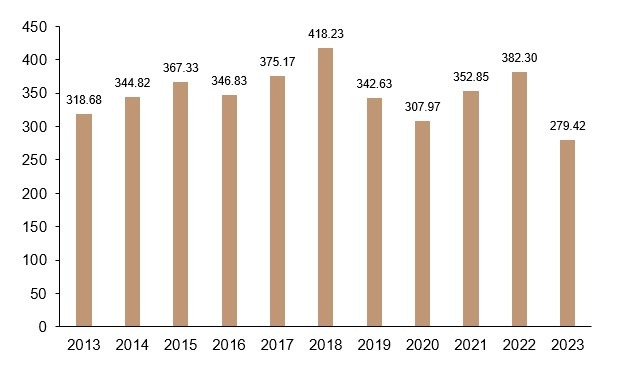
This trade relationship can be seen in the numerous U.S. industries significantly affected by cheaper Chinese exports. For example, the U.S. furniture manufacturing industry saw a significant decline between 1999 and 2009. North Carolina, known as the furniture capital of the world, lost more than half of its jobs as competition from cheaper Chinese goods began to affect the U.S. market. More recently, when China was able to produce solar cells far more cheaply than U.S. companies, the U.S. solar industry witnessed a slew of bankruptcies. In 2023 alone, over 100 companies collapsed, including notable names like SunPower and Titan Solar.
Given this context, Donald Trump has emphasized the need to narrow these trade imbalances with China, adopting a protectionist stance to protect American manufacturing and stir political fervour. However, this is not the first time Trump has taken action against China’s export capacity. His dissatisfaction with the U.S.-China trade relationship can be traced back to his first term as president in 2016 when he launched a series of tariffs in 2018, sparking a series of trade wars between both nations.
China’s Dominance in Exports
China’s trade surplus has been expanding significantly, with projections indicating a possible record of a $1 trillion trade surplus this year. As of October, the surplus nearly reached US$800 billion, marking a 16% increase year on year. This dominance in export is largely propelled by hefty industrial subsidies, which the U.S. argues that it results in an “overcapacity” issue, where production capacity in certain industries surpasses domestic and international demands, resulting in the dumping of goods on the global market at significantly reduced prices, thus distorting market dynamics. According to IMF, it was found that subsidies made up over 95% of all Chinese trade distortive policies between 2009 and 2022. Notably, China introduced approximately 5,400 subsidy measures during this period, constituting about two-thirds of the total measures enacted by G20 economies.
Amid domestic economic struggles, particularly due to a property crisis and low consumer confidence, China has increasingly relied on exports to buffer against weak domestic demand. This reliance has led to the extensive use of subsidies to secure a dominant position in global markets, especially in emerging green technologies such as electric vehicles and renewable energy infrastructures.
Estimates suggest that China’s industrial subsidies are at least three to four times or even up to nine times higher than those in major EU and OECD countries. Other contributing factors include currency interventions to maintain the yuan at a favourable rate, low labour costs, and lax intellectual property policies, enabling Chinese companies to replicate U.S. goods with relative ease.
Actions Taken by the U.S.
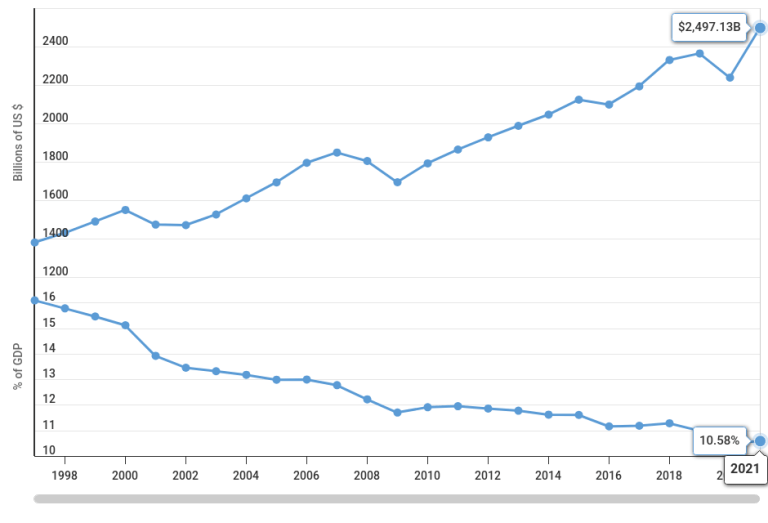
China’s capability to produce goods at significantly lower costs has impacted the competitiveness of the American manufacturing sector, which has seen a declining contribution to the national GDP over the past two decades. Costing the U.S. manufacturing industries a sizeable amount yearly, the Trump administration decided to pursue an aggressive trade policy.
Fig 2. U.S. Manufacturing Trends
During Donald Trump’s first term, the U.S. imposed a 25% tariff on $50 billion worth of Chinese goods in June 2018, covering over 1,300 products including electronics, medical devices, and batteries. China responded by imposing a matching 25% tariff on over 200 U.S. products also valued at $50 billion.
The tariff measures escalated further when, in September 2018, the U.S. levied a 10% tariff on an additional $200 billion worth of Chinese goods, which was increased to 25% in 2019. China retaliated by imposing custom duties on $60 billion worth of U.S. goods.
By the end of 2019, the U.S. had tariffs on approximately $350 billion of Chinese imports, while China had retaliated against $100 billion of U.S. exports. Research, including findings from Stanford University, indicated that these tariffs not only increased prices for consumers, affecting their purchasing power but also reduced the profitability of Chinese exporting firms. Specifically, a 1% increase in tariff-inclusive export price resulted in a 0.35% drop in profit margins for these firms, alongside a 4.16% drop in exports to the U.S.
Despite these efforts, Trump’s goal to reduce the trade deficit was not fully realised. The U.S. continued to experience a trade deficit, albeit at a reduced scale, suggesting that the tariff war did not achieve its intended effects. The economic burden fell heavily on American consumers, who faced nearly $80 billion in increased taxes, amounting to an additional $200 to $300 annually per household.
Under the Biden Administration, the tariffs from the Trump era remained in effect and were expanded to include other sectors. Tariffs on certain Chinese imports, such as medical devices, electric vehicles, and semiconductors, ranged from 7.5% to 100%. Additionally, the Biden Administration adopted stringent policies towards China’s high-tech industries by implementing export controls on essential technologies like semiconductors and chip-making tools, aiming to curb China’s advancements in these critical areas.
What does the Future Hold?
Re-elected President Donald Trump has explicitly stated his intention to increase existing tariffs on Chinese imports by up to 60% and to impose broader tariffs of 10% to 20% on all imports, including those from key allies and trade partners. Trump justifies his aggressive policies as a means to subsidise his plans for cutting corporate taxes and to strengthen America’s international trade position and domestic job growth.
However, there are challenges to implementing these unilateral tariffs. While Trump previously enacted tariffs without Congressional approval, Senator Rick Scott suggests that Trump’s ambitious plan might require Congressional support, and some experts predict legal challenges.
Should Trump’s tariffs be enacted, U.S. citizens could face a significant increase in tax expenditures, reducing their purchasing power—a trend observed since 2019 with lower tariff rates. Moreover, the tariffs could trigger inflation, disrupting federal measures that have eased inflation over the past two years. While this could increase demand for domestically produced goods and potentially boost employment as companies reshore operations, the impact may be limited.
The U.S. economy has shifted towards services over recent decades, and rebuilding manufacturing capacity to meet demand will take time. The high costs associated with establishing industries, coupled with high labour costs and a low unemployment rate, mean that kickstarting the local manufacturing scene could lead to higher pre-tariff goods prices, adversely affecting the U.S. economy, especially since consumers also have reduced purchasing power for service-related goods.
Furthermore, with China’s history of retaliating against Trump’s tariffs, it might employ several countermeasures. Scott Kennedy, a senior adviser at the Center for Strategic and International Studies in Washington, suggests China might target American companies with significant interests in China, sell U.S. Treasuries, devalue the yuan, or increase business with Europe and Latin America. Alternatively, China might mirror U.S. actions and target U.S. imports. With China’s economy slowing, the country might easily switch to other nations to soften the impact of U.S. tariffs. This was evident when China responded to U.S. tariffs on soybeans in 2018 by turning to Brazil as its main soybean supplier. To mitigate this impact, the Chinese government might need to bolster domestic consumption of their goods, potentially involving additional stimulus that the government has been trying to avoid to prevent the reinflation of old economic bubbles.
From this perspective, it appears that new tariff sets could lead to a lose-lose situation for both nations, intensifying a trade war that has been ongoing for the past six years.