

Following Iran’s attacks on Israel in early October, Brent Futures settled above USD 80 for the first time since August, snapping a prolonged streak of downward price trends since July. After a brief rally, Brent Futures slipped back down by over 4% the next day, demonstrating the volatility of energy prices in this tense global environment.
In fact, traditional energy commodities, ranging from oil, natural gases and coal, have experienced either selling pressures or muted price changes, largely attributed to demand concerns from the world’s largest energy importer, China, as it continues to grapple with a nationwide economic slowdown.
Although this downturn in energy prices may be temporary, the recent announcement of a new economic stimulus package by Beijing – aimed at revitalising the world’s second-largest economy – suggests that energy commodities might approach a turning point. Nevertheless, this situation underscores the importance of diversifying away from traditional energy assets to mitigate risks and volatility.
Furthermore, as the global landscape evolves and world leaders champion a transition to cleaner and renewable energy sources and more sustainable and efficient extraction practices, the energy market has shifted significantly over the past decade, opening up fresh opportunities for investors.
The Shift Towards Renewable Energy
As threats of irreversible environmental changes from climate change loom, global leaders are under increasing pressure to adopt renewable energy solutions. Derived from natural sources like solar, wind and water, renewable energy will be a key solution as traditional sources of energy deplete.
Accounting for 43% of global electricity capacity in 2023, some of the world’s leading players in the renewable energy market are China, the U.S. and the European Union (EU).
Fig 1. Leading countries in installed renewable energy capacity worldwide in 2023 (GW)

The “big three” renewable energy sources are solar, hydropower and wind energy, given their accessibility. Beyond sustainability objectives, countries are also pursuing renewable energy in their national interest. For instance, as outlined by the EU’s renewable energy policy, one factor for increased efforts is to reduce the reliance on Russia’s fossil fuels, following the Russian invasion of Ukraine in 2022. Similarly, China views renewable energy as a main driver of economic growth, with clean energy contributing up to 40% of China’s Gross Domestic Product (GDP) in 2023.
While a significant focus is placed among the big three, biofuels – renewable energy sources derived from biomass such as plants, algae material or animal waste – are also gaining traction, particularly in Latin America (LATAM), the EU and Indonesia. Biofuels provide a viable alternative to meet energy demands in the transportation sector. Additionally, they serve as an economic driver for the agricultural sector, while protecting countries from imported inflation stemming from volatile energy prices or foreign exchange fluctuations.
Resurgence in Nuclear Energy Across the West
Apart from renewable energy, nuclear energy is also experiencing a resurgence. Currently, nuclear power provides about 10% of the world’s electricity. Europe is currently the leading adopter of nuclear energy, with nations like France and Hungary relying on nuclear to generate more than half of the national electricity supply. While opportunities might be limited due to its state-owned nature, there is still ample room for growth in this sector.
Following the disastrous Fukushima nuclear accident in 2011, fear surrounding nuclear energy has gradually subsided, as more countries have successfully implemented safe nuclear energy transitions, reinforced by stricter international and domestic policies, as well as advancements in technology that enhance efficiency and safety.
While there is still a notable divide within the EU regarding the integration of nuclear energy – evident in countries like Spain and Germany, which have recently decided to phase out their nuclear fleets – nuclear energy continues to show promise, particularly in the growing segment of Small Modular Reactors (SMR) in the U.S. and United Kingdom (UK), which are spearheading the next wave of nuclear innovation.
Fig 2. Americans who continue to support nuclear power in the U.S. (%)

Fig 3. Attitude towards nuclear energy in the UK (% of respondents)

As public perception of nuclear energy becomes more favourable, SMRs present a unique and promising opportunity. SMRs require a lower capital investment while offering greater scalability and siting flexibility for locations unable to accommodate traditional larger reactors. Several companies in the U.S. market such as Oklo and NuScale are in the process of establishing SMR plants to serve more isolated regions, tapping into an underserved market and commanding a premium by providing energy to these areas. Likewise, the UK has set an ambitious target of nuclear capacity to increase its nuclear capacity to 24 GW by 2050, up from the current 6.5 GW, much of which is set to be decommissioned within the next decade.
SMRs can be utilised this way to bridge the impending gap in power generation capacity, while leveraging UK’s robust manufacturing infrastructure to reduce costs, as SMRs are factory-made. Moreover, with the rise of electricity-hungry data infrastructures driven by the increasing integration of Artificial Intelligence (AI) into our daily lives, regions in the U.S. are experiencing power crunches. In this context, SMR offers a flexible alternative to traditional energy suppliers while providing locational advantages for supporting space-intensive AI infrastructures.
Alternative Fuels and the Shipping Industry
Shipping is responsible for transporting approximately 80% of the world’s trade, serving as a backbone of global economy. Despite its importance, shipping is environmentally unfriendly, contributing to nearly 3% of total global emissions.
To better align with global sustainability efforts, the International Maritime Organization (IMO) has laid out an ambitious target to reducing emissions by at least 50% by 2050. Green Shipping Corridors are central to achieving this target.
A green shipping corridor is a shipping route on which zero-carbon emissions ships and other emissions reduction programmes are deployed, and emissions reductions are measured and enabled through public and private actions and policies. A crucial element of these green shipping corridors is the usage of alternative fuels, such as biofuels and hydrogens. An example of this shift is Monjasa, one of the world’s largest marine fuel suppliers, which has expanded its operations to accommodate 5,000 to 7,000 metric tonnes of second-generation biofuels each month.
In addition to biofuels, hydrogen and ammonia are also promising candidates for clean fuel alternatives to support the decarbonisation movement. Although these fuels have not yet been widely adopted, each has unique strengths that could revolutionise the energy and shipping sectors in the future. While hydrogen or ammonia powered vessels are still novel concepts, hydrogen is produced in large quantities globally and can be stored efficiently for long periods using fuel cell technology, making it advantageous not only for shipping, but also for other industries like industrials and energy. Likewise, ammonia is another zero-emission fuel with high energy density, making it suitable for supplying power to large vessels.
Changes in Energy Production
As traditional energy sources like conventional oil and gas dwindle, the industry has pivoted to alternatives such as shale and deep-sea oil extraction. This shift raises production costs, impacting the broader economy. For example, fracking has made the U.S. a top oil producer, but it’s labor- and resource-intensive, with higher breakeven costs. According to Rystad Energy, Middle Eastern onshore oil, a conventional method, breaks even at around USD 27 per barrel, while North American shale oil is closer to USD 45, with other unconventional methods reaching USD 75.
This transition has also led to a decline in Energy Return on Investment (EROI) for oil. The Society of Petroleum Energy notes that the energy required for oil production is increasing exponentially, projected to reach half of gross energy production by 2050, signalling reduced efficiency and rising costs.
In contrast, renewable energy costs, especially for wind and solar, are expected to drop due to falling capital expenses driven by competition among Chinese manufacturers. Wood Mackenzie forecasts that by 2030, renewables will be 32% cheaper than low-cost coal, making them increasingly competitive.
Opportunities ahead
Clean energy, an attractive entry point
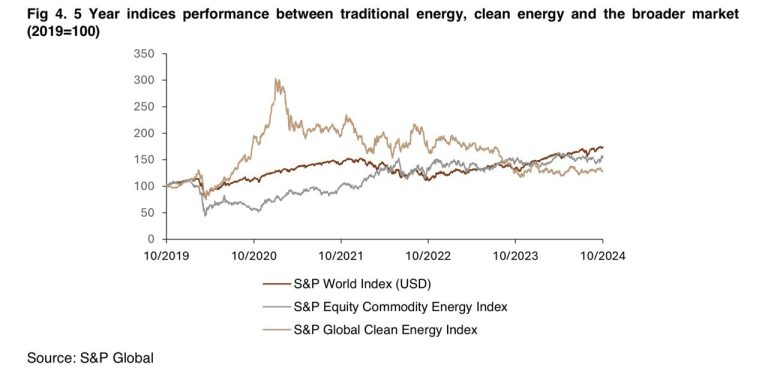
Although this downtrend may concern investors, the current macroeconomic environment could signal a turning point for the industry. Two primary factors explain the slowdown in clean energy growth: rising interest rates and inflationary pressures. High interest rates have restricted access to capital, hindering investments in the sector, which is particularly sensitive due to its high upfront costs and long payback periods. Additionally, persistently high interest rates have squeezed the margins of clean energy companies, impacting overall profitability.
With a soft-landing scenario materialising for several economies worldwide, most notably the U.S. and EU, central banks worldwide have been gradually cutting interest rates. Likewise, inflationary pressures have eased recently. All these signals are pushing for a potential inflection point, making clean energy an increasingly attractive candidate for the long term. Despite these positive signs, supply chain disruptions attributed to the ongoing patchy geopolitical climate pose a possible risk that could threaten the clean energy sectors.
Traditional energy commodities
While traditional energy commodities are bound to face competitive pressure in the long future, as the transition into clean energy accelerates while resources deplete, in the medium term, traditional energy commodities will remain a stable source of investment.
Referring to Fig 4., the Equity Commodity Energy index has roughly tracked the World index over a five-year period, demonstrating its stability over the long run, with short-term fluctuations in energy markets having a limited impact. In the near term, traditional energy commodities are still facing pricing pressure as China’s economic outlook remains uncertain and supply remains strong despite production cuts from OPEC+, creating an imbalance in supply and demand.
Given this context, investing in stable companies that provide consistent dividends is recommended to navigate the current environment of uncertainty.
In conclusion, the energy market’s landscape over the past decade has undergone a profound transformation, driven by shifting geopolitical dynamics, technological advancements, and an urgent push for sustainability. The volatility in traditional energy prices, notably affected by global events and economic slowdowns, underscores the need for diversification in energy investments. As renewable energy becomes more central, nations and companies are harnessing innovation to address the environmental and economic demands of the future. Nuclear energy, particularly through Small Modular Reactors, offers a promising new chapter, while alternative fuels signal the shipping industry’s alignment with global decarbonisation goals.
Despite current economic pressures on clean energy investments, evolving macroeconomic trends indicate a potential for a resurgence, providing investors with unique opportunities to support and benefit from the shift towards cleaner, more resilient energy systems. Looking forward, it is crucial to note that balancing investments across both traditional and emerging energy sectors may be key to navigating and capitalising on the next decade of energy evolution.