Huge Asymmetry In Offshore Energy
Since the days of the ‘fracking’ in the Midwest of the US that began more than a decade ago, the offshore oil and gas segment has seen a rough time as crude oil prices were priced lower and onshore production gained market share.
In those days, it wasn’t uncommon to find high breakeven costs for offshore players due to the high operating costs in offshore beds for oil production. With years of low prices, many players have went belly up and the entire industry and its supporting ones have experienced massive consolidations.
But as per the dynamics of the Capital Cycle, cyclical industries that produce what the world needs will bounce back eventually, and the backdrop of low investment in new capacity across the energy space has led to a resurgence in offshore energy once again. And times have changed when it comes to the offshore production costs: they are now cost-competitive with onshore players.
This is a slide from Hess Corporation on the breakeven economics in an offshore area in Guyana:
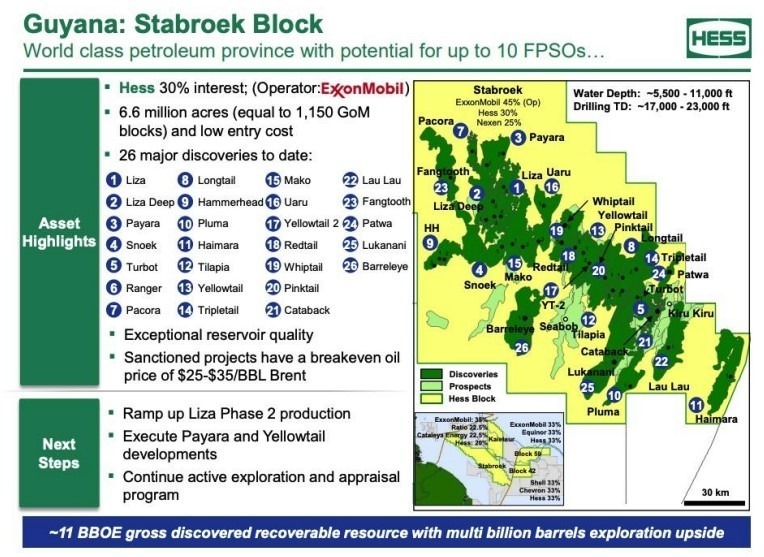
They are doing fine at US$25-US$35 per barrel.
Many offshore players like offshore service vehicles (OSV) companies have seen a boom in their businesses over the past 2 years, and this is because their clients such as Chevron, Exxon and Petrobras are making decade-long bets on offshore oil in places such as Guyana (above), Suriname and the Mexican Gulf.
Baker Hughes and Schlumberger also commented on the secular drivers of offshore production in their recent quarterly reports and calls. Quintin Kneen of Tidewater (an offshore services player) had this to say recently:
“One of the areas in which we’re seeing the most significant growth, and it was illustrated a little bit in the earlier presentations when you look at the Middle East is that they’re doing quite fine at 60 in oil. Brazil’s not stopping at 60, Suriname is not stopping at 60. The investment decisions that are being made are long-term investment decisions. The general view from my perspective is that people believe oil and gas will be constrained over the next five to ten years, so making investments today in a long-term investment is not a problem.”
We like Transocean Ltd (NYSE.RIG), an American offshore drilling services provider that operates in many deep water areas such as the Gulf of Mexico, North Sea, Brazil and western Australia. Its business partners include big players such as Royal Dutch Shell, Equinor and Chevron.
RIG has considerable cash flow generating potential as dayrates and contract term continue to improve despite the macro fears that dominate financial markets at this juncture.
What really caught our attention is the high replacement costs of these offshore rigs and vessels, which itself acts as an inflation hedge. Additionally, after the bust that started more than ten years ago, many shipyards were reluctant to take on new project builds. For those who did take on new builds, upfront deposits of 40-50% and guarantees were demanded, which needless to say makes it difficult for new capacity to kickoff and adds supply-side barriers.
Additionally, there is a long lead time to get new vessels online even if the unfriendly economics can be overcome.
This makes the offshore industry supply-constrained just while demand is exponentially increasing (as explained earlier). RIG being one of the players stand to benefit from this unique industry dynamic to create massive value for shareholders. Dune has built a position in RIG and will continue to do so on favourable technical set-ups moving forward.
Adding on to the many tailwinds behind energy is the prospects of a weaker US Dollar as the macro cycle turns (which is a boon for crude oil prices), and it’s easy to see why we are excited about this space.