
The Long Tail

In ‘Science, energy, ethics, and civilization’, the popular science writer Vaclav Smil (who Bill Gates’ is a fan of) wrote:

In 1922 Alfred Lotka (1880–1949) formulated his law of maximised energy flows: In every instance considered, natural selection will so operate as to increase the total mass of the organic system, to increase the rate of circulation of matter through the system, and to increase the total energy flux through the system so long as there is present and unutilised residue of matter and available energy (Lotka, 1922, p. 148). 

The greatest possible flux of useful energy, the maximum power output (rather than the highest conversion efficiency) thus governs the growth, reproduction, maintenance, and radiation of species and complexification of ecosystems. The physical expression of this tendency is, for example, the successional progression of vegetation communities toward climax ecosystems that maximise their biomass within the given environmental constraints – although many environmental disturbances may prevent an ecosystem from reaching that ideal goal. In the eastern United States, an unusually powerful hurricane may uproot most of the trees before an old-growth forest can maximize its biomass. Human societies are, fundamentally, complex subsystems of the biosphere and hence their evolution also tends to maximise their biomass, their rate of circulation of matter, and hence the total energy flux through the system.” 

Basically, Smil is arguing that:

  • Complex systems naturally trend towards greater complexity and greater energy intensity as long as the physical means to do so remain available
  • Human societies, being a natural form of a complex system, have increased their total energy flux exponentially over-time and are set to continue to do so unless drastic policy measures are taken to slow the trend of consumption
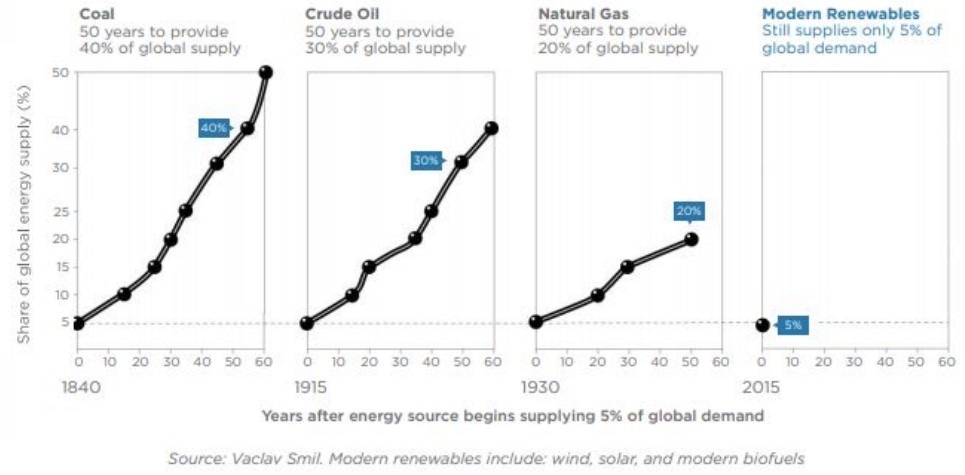
  • Historically, major energy transitions are an incredibly slow-moving process – it typically takes many decades before the up-and-coming energy source comprises any meaningful percentage of the energy mix (referencing the chart below)
As global per capita income rises, we as a species tend to consume more. This assumption is based off a fundamental axiom of human nature – we desire a better life and we strive towards it. Modern economic history ascertains this as our living conditions and quality of life improve generation after generation. We find ways to improve productivity, and innovation drives progress.

This is how the United States of America moved from an emerging market into a developed market and finally emerge as a global superpower. It’s also how Europe flourished and became wealthy after the first and second industrial revolutions kickstarted in Britain and the German Empire respectively. 

But all this is only possible if we are able to rearrange and harness the fundamental blocks of energy for us to consume and grow as a civilisation. All the industrial revolutions were triggered by some new way to improve productivity that is built off some new way of harnessing energy molecules for our lives.

And in the rapidly-moving twenty-first century, innovation and technological advancement will only mean we require more energy. Affluent wealth implies that the consumption habits of developing markets will trend towards those of the developed world. As Smil and Lotka put it, this equates to a much greater energy flux as interactions across the world become more complex.


ESG Agendas Do Not Stop The Inexorable Demand For Energy

Over the past few years, the narrative of climate change has been at the forefront of governments, big corporations, and dominating conversations over social discussions. The media’s focus on various weather developments and the hijacking of institutions by leftist liberals have accentuated this narrative till the present day. 

Most of the world is forced to pivot to address these issues for fear of being “cancelled” and made irrelevant by social pressures. This has led to a lack of new investment in viable projects in the energy space to fulfill incoming demand in the years ahead.


Unfortunately for the climate-change activists, energy transitions take time. We’ve always known this at Dune, but policymakers have finally realised that the world cannot leap straightaway to renewable sources as clean infrastructure requires investment and renewable sources like Wind and Solar are intermittent.

Renewable energy certainly has its benefits, but this means that the world cannot wean off fossil fuels as much as the activists hope for. We are simply addicted to fossil fuels and are actually using more of it daily as emerging markets consume more due to rising affluence.

Here’s Vaclav Smil again from “How The World Really Works” :

“For those who ignore the energetic and material imperatives of our world, those who prefer mantras of green solutions to understanding how we have come to this point, the prescription is easy: just decarbonize—switch from burning fossil carbon to converting inexhaustible flows of renewable energies. The real wrench in the works: we are a fossil-fueled civilization whose technical and scientific advances, quality of life, and prosperity rest on the combustion of huge quantities of fossil carbon, and we cannot simply walk away from this critical determinant of our fortunes in a few decades, never mind years.”

Interestingly, investor interest for the energy sector isn’t exactly ‘hot’. In the US equity market, the energy sector remains in the low single digits as a percentage-wise of overall market capitalisation (although it has definitely risen since 2021 after the world woke up to the reality that we cannot get rid of fossil fuels), as shown in the chart below.
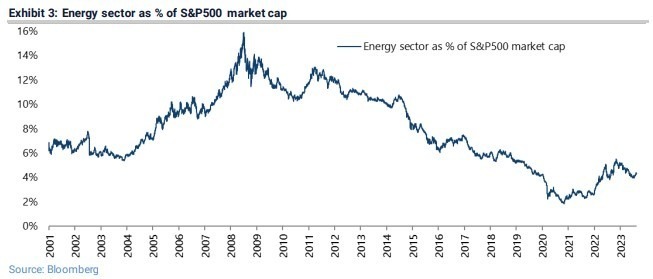
Source: Christopher Wood’s Greed & Fear, Jefferies. As of 17 August 2023

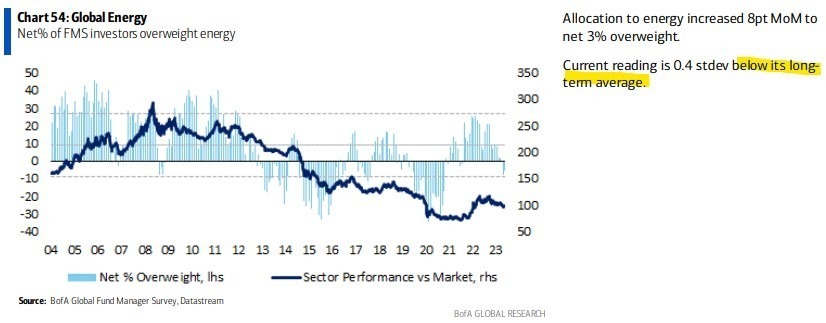
The latest investor surveys from Bank of America also illustrated the lack of interest among fund management professionals for the energy sector as recession concerns linger:
We managed to monetise the upward re-ratings in natural gas and coal plays and played the narrative well over the past few years. But with the world now realising that oil remains vital for the survival of civilisation, it’s about time to focus on oil and gas.

In investing, the best trades are the ones where we stack positive condition upon condition upon condition. When we do that, it makes it very difficult to lose and easy to win, creating a kind of conditional asymmetry that we can exploit and make multiples on our capital invested. The set-up in oil and gas gets more interesting week by week, with the downside increasingly limited while the potential upside is simply extraordinary.

And it’s in offshore energy that the real money is to be made.

In ‘Science, energy, ethics, and civilization’, the popular science writer Vaclav Smil (who Bill Gates’ is a fan of) wrote:

In 1922 Alfred Lotka (1880–1949) formulated his law of maximised energy flows: In every instance considered, natural selection will so operate as to increase the total mass of the organic system, to increase the rate of circulation of matter through the system, and to increase the total energy flux through the system so long as there is present and unutilised residue of matter and available energy (Lotka, 1922, p. 148). 

The greatest possible flux of useful energy, the maximum power output (rather than the highest conversion efficiency) thus governs the growth, reproduction, maintenance, and radiation of species and complexification of ecosystems. The physical expression of this tendency is, for example, the successional progression of vegetation communities toward climax ecosystems that maximise their biomass within the given environmental constraints – although many environmental disturbances may prevent an ecosystem from reaching that ideal goal. In the eastern United States, an unusually powerful hurricane may uproot most of the trees before an old-growth forest can maximize its biomass. Human societies are, fundamentally, complex subsystems of the biosphere and hence their evolution also tends to maximise their biomass, their rate of circulation of matter, and hence the total energy flux through the system.” 

Basically, Smil is arguing that:

  • Complex systems naturally trend towards greater complexity and greater energy intensity as long as the physical means to do so remain available
  • Human societies, being a natural form of a complex system, have increased their total energy flux exponentially over-time and are set to continue to do so unless drastic policy measures are taken to slow the trend of consumption
  • Historically, major energy transitions are an incredibly slow-moving process – it typically takes many decades before the up-and-coming energy source comprises any meaningful percentage of the energy mix (referencing the chart below)

As global per capita income rises, we as a species tend to consume more. This assumption is based off a fundamental axiom of human nature – we desire a better life and we strive towards it. Modern economic history ascertains this as our living conditions and quality of life improve generation after generation. We find ways to improve productivity, and innovation drives progress.

This is how the United States of America moved from an emerging market into a developed market and finally emerge as a global superpower. It’s also how Europe flourished and became wealthy after the first and second industrial revolutions kickstarted in Britain and the German Empire respectively. 

But all this is only possible if we are able to rearrange and harness the fundamental blocks of energy for us to consume and grow as a civilisation. All the industrial revolutions were triggered by some new way to improve productivity that is built off some new way of harnessing energy molecules for our lives.

And in the rapidly-moving twenty-first century, innovation and technological advancement will only mean we require more energy. Affluent wealth implies that the consumption habits of developing markets will trend towards those of the developed world. As Smil and Lotka put it, this equates to a much greater energy flux as interactions across the world become more complex.


ESG Agendas Do Not Stop The Inexorable Demand For Energy

Over the past few years, the narrative of climate change has been at the forefront of governments, big corporations, and dominating conversations over social discussions. The media’s focus on various weather developments and the hijacking of institutions by leftist liberals have accentuated this narrative till the present day. 

Most of the world is forced to pivot to address these issues for fear of being “cancelled” and made irrelevant by social pressures. This has led to a lack of new investment in viable projects in the energy space to fulfill incoming demand in the years ahead.

Unfortunately for the climate-change activists, energy transitions take time. We’ve always known this at Dune, but policymakers have finally realised that the world cannot leap straightaway to renewable sources as clean infrastructure requires investment and renewable sources like Wind and Solar are intermittent.

Renewable energy certainly has its benefits, but this means that the world cannot wean off fossil fuels as much as the activists hope for. We are simply addicted to fossil fuels and are actually using more of it daily as emerging markets consume more due to rising affluence.

Here’s Vaclav Smil again from “How The World Really Works” :

“For those who ignore the energetic and material imperatives of our world, those who prefer mantras of green solutions to understanding how we have come to this point, the prescription is easy: just decarbonize—switch from burning fossil carbon to converting inexhaustible flows of renewable energies. The real wrench in the works: we are a fossil-fueled civilization whose technical and scientific advances, quality of life, and prosperity rest on the combustion of huge quantities of fossil carbon, and we cannot simply walk away from this critical determinant of our fortunes in a few decades, never mind years.”

Interestingly, investor interest for the energy sector isn’t exactly ‘hot’. In the US equity market, the energy sector remains in the low single digits as a percentage-wise of overall market capitalisation (although it has definitely risen since 2021 after the world woke up to the reality that we cannot get rid of fossil fuels), as shown in the chart below.

Source: Christopher Wood’s Greed & Fear, Jefferies. As of 17 August 2023

The latest investor surveys from Bank of America also illustrated the lack of interest among fund management professionals for the energy sector as recession concerns linger:

We managed to monetise the upward re-ratings in natural gas and coal plays and played the narrative well over the past few years. But with the world now realising that oil remains vital for the survival of civilisation, it’s about time to focus on oil and gas.

In investing, the best trades are the ones where we stack positive condition upon condition upon condition. When we do that, it makes it very difficult to lose and easy to win, creating a kind of conditional asymmetry that we can exploit and make multiples on our capital invested. The set-up in oil and gas gets more interesting week by week, with the downside increasingly limited while the potential upside is simply extraordinary.

And it’s in offshore energy that the real money is to be made.