

Gold As A Neutral Reserve Asset

picture of american bank on wall street

“A Fourth Turning lends people of all ages what is literally a once-in-a-lifetime opportunity to heal (or destroy) the very heart of the republic.”

William Strauss, The Fourth Turning

Gold As A Neutral Reserve Asset

The de-dollarization narrative is trendy these days, and if Sentiment Trading has proven itself to be one of the most reliable indicators, this camp is rather crowded. When it comes to the Dollar, there are two very distinct features to it; one is the Dollar as a Global Reserve Currency, and the other is the Dollar as a Global Settlement Currency. Both roles serve very different purposes, and any Dollar debates should consider these two proponents. There are a lot of strawman arguments these days when it comes to the Dollar, and most people just understand the Dollar as a Global Reserve Currency; on that basis, the Dollar has no threat of being supplanted. The United States, since 1971, had enjoyed “exorbitant privilege” when the Oil for Guns & Defence barter was made with the Saudis. This exorbitant privilege juiced the US economy while making the USD America’s largest export. To do this, America has to maintain an Open Capital account which over time came at a considerable expense to the vitality of America’s industrial base and domestic ownership of assets. America currently runs a massive Twin Deficit, the deepest Negative Net International Investment Position (NIIP), which suggests that they are vulnerable to financial warfare should foreign emissaries decide to band together and a hollowed-out industrial and manufacturing base due to the financialization of the economy. Which emerging superpower is willing to bear the brunt of this “burden”? In a hypothetical sense, let’s assume China is ready to take on the role of Reserve Currency. Can you imagine what will happen to their capital outflow issues once that happens? It’s going to be a release the Kraken moment for the Middle Kingdom. Enter the other potential proverbial contender, Europe. The EU is politically fragmented with bifurcated economic interests within its sphere (no political union); lynchpin countries of the EU, like Germany, have put their economies at the utter mercy of Russian energy flows due to poor energy policy choices. With no political union, there can never be a fiscal union, let alone a unified will to pursue what it takes to be a Global Reserve Currency.

Whether the value of the USD will erode over time is another question altogether. Hence in a metaphorical sense, the role of Global Reserve Currency is an iatrogenic disease (in medical terms, iatrogenic is an adjective used to describe a medical disorder, illness, or injury caused in the process of medical treatment) that is similar to the law of diminishing returns over time given human tendencies to abuse such power (unlimited/unchecked monetary expansion) to save the vestiges of an empire. In current contexts, as more banks fail, the Fed’s balance sheet must grow further. The current slowdown in inflation will reverse (just as what occurred in the 1970s, with inflation coming in discrete waves). The resulting inflation (combined with scarcity caused by left-wing green regulatory policies) will prompt it to hold rates “higher for longer.” And yet this policy will create more chaos in the credit markets and eventually will undermine the Fed’s own balance sheet and that of the U.S. government. At some point, the Fed will have to decide whether to defend the dollar or prop up the banking system and support the state. The fractional reserve process, which is able to turn $10 cash into $100 credit money, is sputtering and will start to work in reverse. The prices of assets will go down with the decrease in credit, even while the costs of goods will go up with the increase in currency.

This is the same phenomenon that strikes all inflationary economies eventually, and it makes the middle class poor fast. As this process happens, the Fed will have no intellectual tools to understand it. Banking School and Currency School thinking were unified for so long that modern economists are barely aware of the distinction. As in the early nineteenth century, they will have no consensus on why prices are increasing nor how to address it. It will be crisis management of ever-increasing frequency and intensity.

In this regard, we believe that the USD will continue to be the Global Reserve Currency because no economy in the world has a strong enough military, the rule of law and a deep enough debt market, let alone have the slightest inclination to bear this burden.

Regarding Global Settlement, the largest buyer of a commodity will almost always eventually have pricing and settlement power. Enter the case of China, which is the main protagonist of the “de-dollarization” narrative. China has undoubtedly surpassed the US in terms of commodity consumption, and it comes as no surprise that suppliers have perked up at China’s behest in recent times as their economic clout is now material to global trade. This move by China is more defensive rather than offensive, in my opinion. Keeping in mind the aforementioned reasons that China has no intentions and cannot afford to be a Global Reserve currency that requires an Open Capital account, why the push by the Middle Kingdom for non-USD settlements in commodities?

  • First, we must understand how much of a country’s negative or positive trade balance is driven by energy imports or exports.

  • Second, understand what would happen to an energy-importing nation’s trade balance if it could import its energy in a currency it can print or what reserve asset an oil exporter could store non-USD surpluses in (gold.)

  • Third, understand how much less foreign FX reserve UST demand there will be from these oil importers and oil exporters over time as the marginal oil barrel can be priced in non-USD (not is, just can be, because the marginal barrel prices the whole, so marginal barrel in non-USD will increase the ability for these nations to control their FX x-rates v. the USD.)

China’s import side of the trade balance is largely made up of oil imports denominated in USD. Because energy is priced in Dollars, America can leverage its “exorbitant privilege” to weaponize the Dollar by creating unfavourable FX & Interest Rate differentials (strengthen USD to make Dollar denominated loans and commodity settlement expensive ie. exporting inflation) that can tilt China’s current account balance from a healthy surplus to a deficit. By being able to settle imports in RMB, China can recycle or print RMB to pay for essentials, cutting the cord of the Dollar wrecking ball and taking back a good chunk of control over their current account balance. This inadvertently gives the CCP better control over inflation, a cornerstone social contract that the Chinese government signed with the people of China, a spectre that the Chinese government is most afraid of, as many civil wars in China were started by inflation-induced poverty. The ensuing question to ask is why countries would want to settle in RMB when there is no liquid debt market to recycle the surplus. Nations that choose to settle in RMB payments are usually what 13D very aptly calls the “Alliance Of The Aggrieved”. These are countries that have their economies suppressed by the USD wrecking ball, and China is stepping in as a market-maker of sorts to take this thorn out of the flesh of this basket-case, but commodity-rich countries. As China (the world’s biggest creditor) and potentially others gain the ability to buy energy in RMB (the currency of a country they are all doing massive trade volumes with anyway), it leads to a structural decline in foreign demand for USTs over time, just as US deficits rise structurally. RMB commodity pricing means the commodity producer and China now have a lever of control over the CNY/USD cross-rate, which means they have gained significant control over their own economic destiny (and USD liquidity levels), and therefore gain an increased measure of economic independence from the US Fed and US Treasury. In short, RMB-denominated energy and commodities “de-weaponize” the USD.

Does this increase these countries’ exposure to China? Yes. Does it increase their risk on FX? That depends. Foreigners can settle any offshore CNH balances in Chinese goods or gold, which has not only risen secularly in CNY terms.
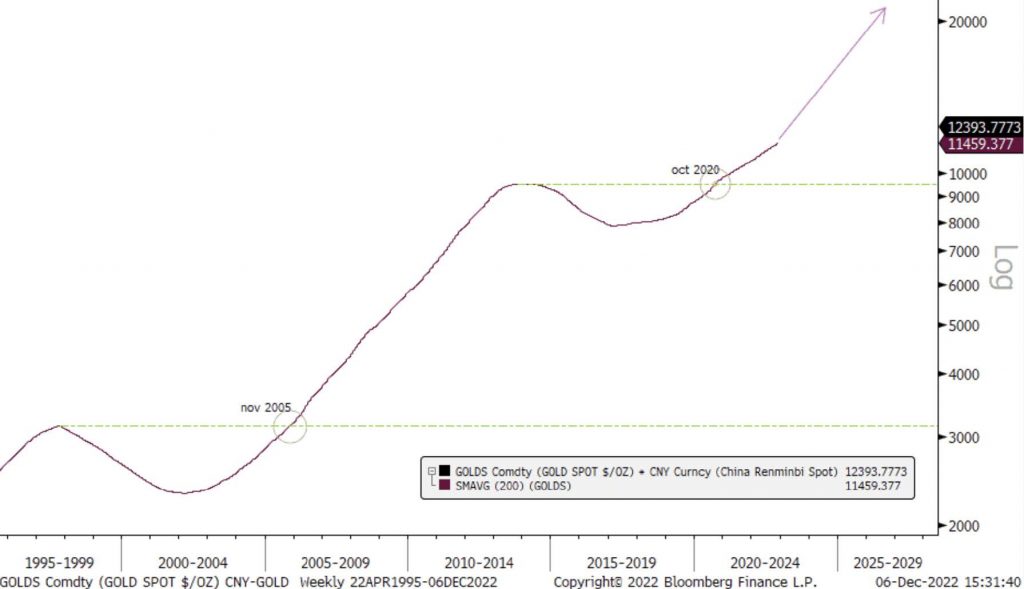
One way China expertly circumvent the need for a deep debt market to place itself as a strong contender for “global king player” is the launch of the Shanghai Gold Exchange, where they seek to make RMB convertible to Gold. Gold, and by extension, Bitcoin, is the smoking gun for the effects of monetary debasement, something the West is deeply entrenched in. China has been making use of Western suppression of Physical Gold prices via the paper markets to accumulate significant holdings of the metal and is still on a massive buying spree; in this regard, China is playing chess while the US is playing checkers. The coup de grace occurs when RMB surplus by energy exporters bids for Gold on the Shanghai exchange and prices become unhinged from Western paper markets. The energy market is 15x larger than Gold; if energy players decide to move away from US Treasury backed Dollars which are increasingly giving Negative Real-Yields anyway, to an RMB convertible Gold contract, China’s reserves will massively revalue in a short period of time just when Western coffers are almost empty of the yellow metal. This speculation may seem a little rich at this point in time, but little birds are already moving towards that direction(Ghana).

For now, the RMB is like Amazon credits, if it’s a $100 credit, you wouldn’t mind keeping it in Amazon points to settle next month’s bill, but if it’s a $100,000, countries will still prefer to hold USD. RMB as a Global Settlement Currency is definitely gaining traction. However, as a reserve currency, many nuances still need to be ironed out and economic infrastructure to be in place. At this point, the de-dollarization narrative is too loud, and the USD will likely surprise to the upside.

What if peace breaks out?

Another thing that’s on my mind is the idea of peace. At this point, it seems farfetched with all the talk about a Spring counter-offensive by the Ukraine Armed Forces and videos of Phosphorus bombs used on Bakhmut, which is terrifying as hell (unfortunately as of this writing 22nd May 2023, it appears that Bakhmut has fallen to the Russians). And it may also seem tone-deaf to talk about portfolio positioning when war and death are going on; such is life, and we have to consider how global events will shape the trajectory of the world and position for it. What caught my attention is Xi’s current attempt to broker peace amongst the nations; what if he indeed succeeds? What if peace breaks out? In addition, one of the biggest tail risks to the West is actually a peaceful reunification of Taiwan, which is increasingly possible with Kuomintang’s stance as opposed to the incumbent Democratic Progressive Party. The KMT argues that Taiwan must accommodate China to some extent to prevent conflict. Ma’s time as president, which included the signing of Economic Cooperation Framework Agreement and a historic meeting with Chinese President Xi Jinping in Singapore, is held up as an exemplar. What will happen to FX, Rates, Commods & Equities and Inflation? Here are some high-level thoughts with regard to the most storied assets.

FX: JPY, CHF⬇  AUD & EMCCYs⬆

RATES: This is tricky because of the massive long positioning in US Treasuries at the Short-End of the curve; market participants will unwind and chase risk assets. Front-End rates may rise significantly as demand will come roaring back, invoking the inflation spectre once again where the Fed is forced to extend higher for longer. Higher for longer will cause more pain for the already fragile banking system, CRE and Shadow Banks, ironically pulling forward a tightening-induced recession as the lagged effects of previous policies may all hit simultaneously. What about the long end? Long-end rates should be less volatile compared to the front-end, and if our prediction of a Fed forced higher for longer as a result of a peace deal occurs, then we are confident that the long-end will remain flat in relation to a Fed-induced policy error that’s waiting to happen. In the meantime, for long-end campers, collect carry and chill as we wait this out, albeit with elevated volatility.

COMMODITIES: Oil & Copper ⬆ Gold is another tricky one here. The abandonment of defensive positioning and, as aforementioned higher real rates due to an unwinding of long bond positions may cause Gold a sharp pullback. However, as inflation rears its ugly head and the Fed is forced to finance deficits in the long run, I believe that Gold will take out the recent highs.

EQUITIES: There is no doubt that Tech equities, especially, will rally hard on the back of a peace deal coupled with an AI narrative tailwind.

“A Fourth Turning lends people of all ages what is literally a once-in-a-lifetime opportunity to heal (or destroy) the very heart of the republic.”

William Strauss, The Fourth Turning

Gold As A Neutral Reserve Asset

The de-dollarization narrative is trendy these days, and if Sentiment Trading has proven itself to be one of the most reliable indicators, this camp is rather crowded. When it comes to the Dollar, there are two very distinct features to it; one is the Dollar as a Global Reserve Currency, and the other is the Dollar as a Global Settlement Currency. Both roles serve very different purposes, and any Dollar debates should consider these two proponents. There are a lot of strawman arguments these days when it comes to the Dollar, and most people just understand the Dollar as a Global Reserve Currency; on that basis, the Dollar has no threat of being supplanted. The United States, since 1971, had enjoyed “exorbitant privilege” when the Oil for Guns & Defence barter was made with the Saudis. This exorbitant privilege juiced the US economy while making the USD America’s largest export. To do this, America has to maintain an Open Capital account which over time came at a considerable expense to the vitality of America’s industrial base and domestic ownership of assets. America currently runs a massive Twin Deficit, the deepest Negative Net International Investment Position (NIIP), which suggests that they are vulnerable to financial warfare should foreign emissaries decide to band together and a hollowed-out industrial and manufacturing base due to the financialization of the economy. Which emerging superpower is willing to bear the brunt of this “burden”? In a hypothetical sense, let’s assume China is ready to take on the role of Reserve Currency. Can you imagine what will happen to their capital outflow issues once that happens? It’s going to be a release the Kraken moment for the Middle Kingdom. Enter the other potential proverbial contender, Europe. The EU is politically fragmented with bifurcated economic interests within its sphere (no political union); lynchpin countries of the EU, like Germany, have put their economies at the utter mercy of Russian energy flows due to poor energy policy choices. With no political union, there can never be a fiscal union, let alone a unified will to pursue what it takes to be a Global Reserve Currency.

Whether the value of the USD will erode over time is another question altogether. Hence in a metaphorical sense, the role of Global Reserve Currency is an iatrogenic disease (in medical terms, iatrogenic is an adjective used to describe a medical disorder, illness, or injury caused in the process of medical treatment) that is similar to the law of diminishing returns over time given human tendencies to abuse such power (unlimited/unchecked monetary expansion) to save the vestiges of an empire. In current contexts, as more banks fail, the Fed’s balance sheet must grow further. The current slowdown in inflation will reverse (just as what occurred in the 1970s, with inflation coming in discrete waves). The resulting inflation (combined with scarcity caused by left-wing green regulatory policies) will prompt it to hold rates “higher for longer.” And yet this policy will create more chaos in the credit markets and eventually will undermine the Fed’s own balance sheet and that of the U.S. government. At some point, the Fed will have to decide whether to defend the dollar or prop up the banking system and support the state. The fractional reserve process, which is able to turn $10 cash into $100 credit money, is sputtering and will start to work in reverse. The prices of assets will go down with the decrease in credit, even while the costs of goods will go up with the increase in currency.

This is the same phenomenon that strikes all inflationary economies eventually, and it makes the middle class poor fast. As this process happens, the Fed will have no intellectual tools to understand it. Banking School and Currency School thinking were unified for so long that modern economists are barely aware of the distinction. As in the early nineteenth century, they will have no consensus on why prices are increasing nor how to address it. It will be crisis management of ever-increasing frequency and intensity.

In this regard, we believe that the USD will continue to be the Global Reserve Currency because no economy in the world has a strong enough military, the rule of law and a deep enough debt market, let alone have the slightest inclination to bear this burden.

Regarding Global Settlement, the largest buyer of a commodity will almost always eventually have pricing and settlement power. Enter the case of China, which is the main protagonist of the “de-dollarization” narrative. China has undoubtedly surpassed the US in terms of commodity consumption, and it comes as no surprise that suppliers have perked up at China’s behest in recent times as their economic clout is now material to global trade. This move by China is more defensive rather than offensive, in my opinion. Keeping in mind the aforementioned reasons that China has no intentions and cannot afford to be a Global Reserve currency that requires an Open Capital account, why the push by the Middle Kingdom for non-USD settlements in commodities?

  • First, we must understand how much of a country’s negative or positive trade balance is driven by energy imports or exports.

  • Second, understand what would happen to an energy-importing nation’s trade balance if it could import its energy in a currency it can print or what reserve asset an oil exporter could store non-USD surpluses in (gold.)

  • Third, understand how much less foreign FX reserve UST demand there will be from these oil importers and oil exporters over time as the marginal oil barrel can be priced in non-USD (not is, just can be, because the marginal barrel prices the whole, so marginal barrel in non-USD will increase the ability for these nations to control their FX x-rates v. the USD.)

China’s import side of the trade balance is largely made up of oil imports denominated in USD. Because energy is priced in Dollars, America can leverage its “exorbitant privilege” to weaponize the Dollar by creating unfavourable FX & Interest Rate differentials (strengthen USD to make Dollar denominated loans and commodity settlement expensive ie. exporting inflation) that can tilt China’s current account balance from a healthy surplus to a deficit. By being able to settle imports in RMB, China can recycle or print RMB to pay for essentials, cutting the cord of the Dollar wrecking ball and taking back a good chunk of control over their current account balance. This inadvertently gives the CCP better control over inflation, a cornerstone social contract that the Chinese government signed with the people of China, a spectre that the Chinese government is most afraid of, as many civil wars in China were started by inflation-induced poverty. The ensuing question to ask is why countries would want to settle in RMB when there is no liquid debt market to recycle the surplus. Nations that choose to settle in RMB payments are usually what 13D very aptly calls the “Alliance Of The Aggrieved”. These are countries that have their economies suppressed by the USD wrecking ball, and China is stepping in as a market-maker of sorts to take this thorn out of the flesh of this basket-case, but commodity-rich countries. As China (the world’s biggest creditor) and potentially others gain the ability to buy energy in RMB (the currency of a country they are all doing massive trade volumes with anyway), it leads to a structural decline in foreign demand for USTs over time, just as US deficits rise structurally. RMB commodity pricing means the commodity producer and China now have a lever of control over the CNY/USD cross-rate, which means they have gained significant control over their own economic destiny (and USD liquidity levels), and therefore gain an increased measure of economic independence from the US Fed and US Treasury. In short, RMB-denominated energy and commodities “de-weaponize” the USD.

Does this increase these countries’ exposure to China? Yes. Does it increase their risk on FX? That depends. Foreigners can settle any offshore CNH balances in Chinese goods or gold, which has not only risen secularly in CNY terms.

One way China expertly circumvent the need for a deep debt market to place itself as a strong contender for “global king player” is the launch of the Shanghai Gold Exchange, where they seek to make RMB convertible to Gold. Gold, and by extension, Bitcoin, is the smoking gun for the effects of monetary debasement, something the West is deeply entrenched in. China has been making use of Western suppression of Physical Gold prices via the paper markets to accumulate significant holdings of the metal and is still on a massive buying spree; in this regard, China is playing chess while the US is playing checkers. The coup de grace occurs when RMB surplus by energy exporters bids for Gold on the Shanghai exchange and prices become unhinged from Western paper markets. The energy market is 15x larger than Gold; if energy players decide to move away from US Treasury backed Dollars which are increasingly giving Negative Real-Yields anyway, to an RMB convertible Gold contract, China’s reserves will massively revalue in a short period of time just when Western coffers are almost empty of the yellow metal. This speculation may seem a little rich at this point in time, but little birds are already moving towards that direction(Ghana).

For now, the RMB is like Amazon credits, if it’s a $100 credit, you wouldn’t mind keeping it in Amazon points to settle next month’s bill, but if it’s a $100,000, countries will still prefer to hold USD. RMB as a Global Settlement Currency is definitely gaining traction. However, as a reserve currency, many nuances still need to be ironed out and economic infrastructure to be in place. At this point, the de-dollarization narrative is too loud, and the USD will likely surprise to the upside.

What if peace breaks out?

Another thing that’s on my mind is the idea of peace. At this point, it seems farfetched with all the talk about a Spring counter-offensive by the Ukraine Armed Forces and videos of Phosphorus bombs used on Bakhmut, which is terrifying as hell (unfortunately as of this writing 22nd May 2023, it appears that Bakhmut has fallen to the Russians). And it may also seem tone-deaf to talk about portfolio positioning when war and death are going on; such is life, and we have to consider how global events will shape the trajectory of the world and position for it. What caught my attention is Xi’s current attempt to broker peace amongst the nations; what if he indeed succeeds? What if peace breaks out? In addition, one of the biggest tail risks to the West is actually a peaceful reunification of Taiwan, which is increasingly possible with Kuomintang’s stance as opposed to the incumbent Democratic Progressive Party. The KMT argues that Taiwan must accommodate China to some extent to prevent conflict. Ma’s time as president, which included the signing of Economic Cooperation Framework Agreement and a historic meeting with Chinese President Xi Jinping in Singapore, is held up as an exemplar. What will happen to FX, Rates, Commods & Equities and Inflation? Here are some high-level thoughts with regard to the most storied assets.

FX: JPY, CHF⬇  AUD & EMCCYs⬆

RATES: This is tricky because of the massive long positioning in US Treasuries at the Short-End of the curve; market participants will unwind and chase risk assets. Front-End rates may rise significantly as demand will come roaring back, invoking the inflation spectre once again where the Fed is forced to extend higher for longer. Higher for longer will cause more pain for the already fragile banking system, CRE and Shadow Banks, ironically pulling forward a tightening-induced recession as the lagged effects of previous policies may all hit simultaneously. What about the long end? Long-end rates should be less volatile compared to the front-end, and if our prediction of a Fed forced higher for longer as a result of a peace deal occurs, then we are confident that the long-end will remain flat in relation to a Fed-induced policy error that’s waiting to happen. In the meantime, for long-end campers, collect carry and chill as we wait this out, albeit with elevated volatility.

COMMODITIES: Oil & Copper ⬆ Gold is another tricky one here. The abandonment of defensive positioning and, as aforementioned higher real rates due to an unwinding of long bond positions may cause Gold a sharp pullback. However, as inflation rears its ugly head and the Fed is forced to finance deficits in the long run, I believe that Gold will take out the recent highs.

EQUITIES: There is no doubt that Tech equities, especially, will rally hard on the back of a peace deal coupled with an AI narrative tailwind.